

Marketing for architects and architecture firms comes down to five jobs, done roughly in this order: decide which clients you want, make the firm easy for them to check, start conversations with those clients and the people who refer them, become findable in search and AI answers, and earn mentions in the places your clients already read.
Relationships with a few dozen companies and referral partners do most of the work. Everything else makes those relationships easier to start and easier to say yes to.
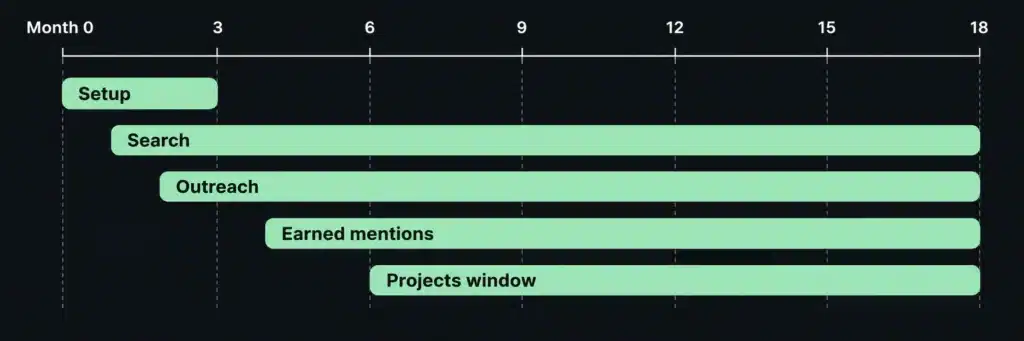
Expect it to take longer than you’d like. Across our client programs, new relationships turn into real conversations within 3 to 6 months and into projects between months 6 and 18. None of our clients have won a project in the first four to six months.
This guide walks through each step with the timings and results we’ve seen. If you came here looking for a team to run it with you, here’s how UNCOMMON works with architecture firms.
What marketing actually wins work for an architecture firm?
A marketing strategy that wins work for an architecture firm rests on relationships with a defined set of clients, backed by proof those clients can check quickly. The channels matter less than the order you build them in and how long you give each one before you judge it.
Here’s the sequence we run, with the earliest result we’ve seen at each step and where we saw it.
| Step | What it involves | What shows up first, and when | Where we saw it |
|---|---|---|---|
| 1. Decide who it’s for | One or two client types, what they weigh, one sentence on why they’d pick you | A position you can say in one sentence, inside the first month | TECHNE spent its first month here, before any outreach went out |
| 2. Make the firm easy to check | Case studies in the client’s terms, and a site and profiles that hold up when someone clicks | Replies that don’t stall once the prospect has looked at your site | Five of our accounts ran into this in the same week |
| 3. Start conversations | A named list of companies, the referral partners in front of them, outreach about the client’s priorities | Acceptances and replies within weeks, real conversations within 3 to 6 months | Connection acceptance of 37% to 50% and developer reply rates of 25% to 45% across our clients |
| 4. Be findable | Service and project pages, articles that answer client questions, a complete local profile | Impressions first, then clicks, then enquiries, over about a year | Studio Carney went from 20 search impressions a day to more than 24,000 in 12 months |
| 5. Earn mentions elsewhere | Podcasts, trade press, panels, guest articles | Your name on sites your clients read, and in AI answers | We don’t have published client numbers for this step yet |
| Projects | Relationships from steps 3 to 5 turning into fees | Months 6 to 18 | Every client program so far |
Steps 1 and 2 take weeks, and they come first because everything after them depends on them.
Steps 3 and 4 then run side by side. Outreach produces conversations this year; search is slower and builds on itself. If you only have time for one thing this quarter, make it step 3, with a short list of the developers or owners you most want to work with.
Who should the marketing be aimed at?
One or two client types you can name, and the people who refer them. A developer weighs density, entitlement risk, and whether the deal pencils. A homeowner weighs trust, taste and honesty about budget.
A university facilities team weighs procurement and sector track record. Pick one for the next 12 months and write everything for that reader.
Our growth guide maps who decides, refers, and influences for each client type, and the branding guide covers how to position the firm for one kind of client in a sentence that client would care about.
Usually not. It needs to hold up when a prospect clicks through from a message or a referral, and the part that most often fails that check is the case studies.
In one week this summer, five of our accounts ran into the same problem. Outreach was ready to scale, and the websites couldn’t survive the click: missing case studies, stock or AI-generated imagery, no client logos, project links that went nowhere. Every prospect who replies to a message looks at the site. If what they find is a portfolio written for other architects, the conversation stalls there.
What holds up is smaller than a rebuild. Two or three case studies written in the buyer’s terms (the problem, the constraint, the number), a services page that names the client type, and a principal’s LinkedIn profile that tells the same story. TECHNE, whose numbers are in the next section, had a single-page website when we started. Its outreach went out with three assets that gave developers something to evaluate before a first call.
When you’re ready for the full site, what a site needs to turn visits into enquiries covers the structure.
How do architecture firms start conversations with clients they don’t know?
With a named list of companies that build the work you want, the referral partners who sit in front of them, and messages about the client’s priorities: schedule, entitlement risk, cost, whether a site works.
TECHNE is about 10 people in California with more than 350 completed commercial and mixed-use projects. Its edge is getting permits through complex California jurisdictions and fire-zone rules at nearly twice the industry’s average speed. When we started, it had that single-page website, an Instagram account, and almost all of its work arriving by word of mouth. We ran it in this order:
- Month one went to positioning, the ideal client, and a value proposition tested against the market. The line that came out of it: architects who think like developers.
- Three assets the outreach could carry: a tenant improvement permitting fast-track guide, a one-page sheet for brokers, and a set of project case studies.
- Two campaigns side by side, one to commercial developers and one to brokers who could refer more than once, with lists built around communities the founder already belonged to, including the Urban Land Institute.
In five months, including ramp-up, that produced 8 qualified meetings with commercial real estate developers and 13 conversations with brokers and other network contacts. Outreach to developer principals reached up to 50% connection acceptance and a 33% reply rate. How TECHNE built its pipeline in five months has the full setup.
Those rates come mostly from the list. The outreach that performs for our clients is aimed at named accounts, with verified job titles, at companies in active development, and it talks about density, certainty, and economics.
Some search, some ask someone they trust, and whichever way they arrive, they look you up before they get in touch. AI assistants now sit in that path too. They draw on pages search engines have indexed and on what other sites say about you, so the work that makes you findable in search, plus mentions elsewhere, is what gets a firm named in an AI answer.
Which path matters depends on the work. A six-person commercial firm walked us through its three lines of business, and each one arrived a different way. One specialism came through search. A second came through referrals, and the principal was blunt about why: a regional bank client “is not going to search online for somebody to do their bank.” The third arrived by referral and was then vetted on the website, where the buyer decided whether the firm was real. The site showed none of that work.
So search brings in some of your clients and is a credibility check for the rest. Know which is which before you spend a year on SEO.
Where clients do search, the return is real and slow. Studio Carney, a Chicago practice with more than 20 years of custom residential, multifamily, and commercial work, was close to invisible in search when we started: about 20 impressions and 1 or 2 clicks a day, ranking only for its own name. We rebuilt the site, mapped each page to a search a client would type, and published service and location pages, articles, and a glossary, more than 300 pages in all. After six months, we started a backlink campaign.
Over 12 months, the site reached 1.67 million impressions and 3,180 clicks at an average position of 25.4, and daily clicks went from 1 to more than 30. The enquiries included a developer exploring a multi-building apartment project, and a commercial client who found the firm through ChatGPT before getting in touch. The Studio Carney SEO case study has the details.
If you copy one thing from that, copy the mapping of each page to a search a client actually types, and leave the page count. Google’s core updates this year have been hard on thin, templated pages, by most published analyses, and a page with no distinct search behind it is now a risk. The result also took a full year and a principal who kept publishing.
AI answers pick up new pages faster than rankings move. When HH Architects started publishing on its rebuilt site, new posts began appearing in Google’s AI Overviews within about a week, though what showed up varied by keyword, browser, search history, and platform.
What gets a page used in an AI answer is mostly what gets it read: the direct answer in the first lines, specific numbers and situations, and questions answered the way a developer or homeowner would ask them, such as how long entitlement takes in your city. You don’t need a special file or extra markup for it. The method is in the search work that matters most for architecture firms.
Where do PR, podcasts and video fit?
After the position is clear. An AEC podcast appearance or a trade-press piece puts the principal’s name on a site the client already trusts, and those mentions now count twice: once with the reader, and once with AI tools. In Ahrefs’ May 2025 study of 75,000 brands, how often a brand was mentioned across the web correlated far more strongly with appearing in
Google’s AI Overviews than its backlinks did (0.664 against 0.218). That’s a correlation, and the study’s authors are clear it doesn’t prove cause.
We don’t have published client numbers for this step yet, so this section stays short. Two practical notes. A ULI or AIA panel, or a podcast episode, with a published transcript gives search and AI tools something to quote, so ask for one. And an appearance with no clear position behind it makes for a pleasant afternoon and not much else.
Is paid advertising worth it for an architecture firm?
Sometimes, once you can tell where each enquiry came from. We don’t run standalone paid campaigns for clients, so treat this as the view of a team that has tested it on its own account.
Our own test was small. We put about $30 behind a LinkedIn post that was already doing well and ran it for three days. It bought reach and engagement and produced no leads. (It also linked to a playbook instead of our newsletter, which didn’t help.) For a firm selling to developers, the people who engage with a post are worth more as names on an outreach list than as a result in themselves.
When one of our multifamily clients qualified for LinkedIn’s thought leadership ads after more than six months of posting, the plan held the spend until three things were in place: the LinkedIn Insight Tag on the website, a “how did you find us” field on the booking form, and the team trained to record the source of every enquiry. Without those, nobody can say whether the ads worked.
Paid search can earn its place when homeowners in your area search for an architect, your site turns those visits into enquiries, and the form is tracked. For developer, institutional, and corporate work, where a few dozen relationships matter, an ad is a weak substitute for a list and a good message.
Where architecture firm marketing usually stalls
In three places: judging it too early, rushing the setup, and leaving it in one partner’s calendar.
Judging too early looks like a principal checking in at month three, seeing no signed project, and stopping. Across every firm we’ve worked with, no project arrived in the first four to six months. The early months are for watching who accepts, who replies, and who agrees to meet.
Rushing the setup means starting outreach before the position, the case studies, the profiles, and the CRM are ready. In our engagements, the first 90 days build the assets that make the following six months work, and firms that skip ahead see slower traction in every channel afterward.
In firms under 50 people, marketing is usually a partner’s second job on top of a full project load, and the pipeline sits in that partner’s head. It moves when they have a spare hour. A shared list, a CRM with notes, and a weekly slot someone else can run keep it moving when they don’t.
How should a small architecture firm market itself?
Start with one client type, a portfolio cut down to the work that client wants to see, and an outreach routine the principal can keep up every week. A small firm can do this with no ad budget, as long as the routine keeps going for a year or more.
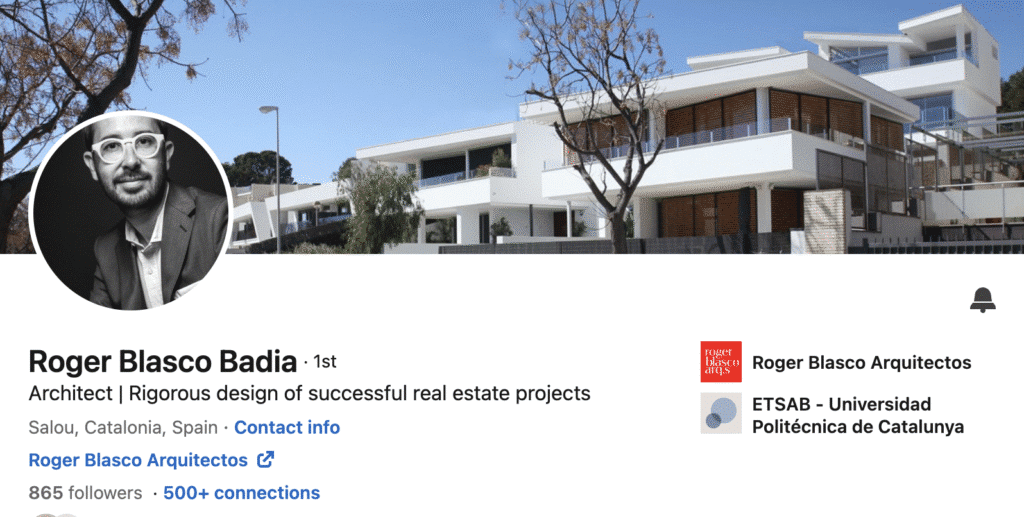
Roger Blasco ARQS is the clearest case we have. When we met Roger, his studio in Salou and Terrassa, in Spain, was two people with more than 15 years of experience and a solid portfolio. Most work came by word of mouth; there was no budget for ads, and the studio was attracting small renovations. The portfolio didn’t speak to the clients Roger most wanted: developers.
We worked through it in order. First, a five-year picture: the projects he wanted, the revenue that would sustain them, and the team needed to deliver them. Then his value to developers, in their terms: speed, predictable returns, and design choices that help a project’s numbers.
Then the portfolio, cut down to the high-end homes, residential developments, and commercial work a developer would care about. Then the routine: weekly LinkedIn outreach to developers, regular posts, structured follow-up, and scripts so he could say the same things on LinkedIn, by email, and across a table.
His first developer clients came within six months, at the early edge of the window above. Qualified leads rose 40%, and his pipeline of qualified opportunities grew threefold. Three years on, the studio has grown from two architects to four, annual revenue is nearly four times what it was, and Roger is developing a multifamily project with one of the most established developers in Tarragona.
Our case study is plain about where the credit sits: Roger applied the system week after week. The steps are in how Roger Blasco ARQS moved from a two-person studio to developer work.
Marketing for architects who design homes
The order shifts for a residential studio, because homeowners search. Get findable locally first: a complete Google Business Profile, and service and project pages written around the neighborhoods you work in. Then build the realtor and builder network, which is often the single biggest source of residential work.
Studio Couture, which designs $5M to $10M homes across Marin County, did both. We rebuilt its website on a new domain and published local SEO content as pages on the site, alongside LinkedIn outreach that drew more than 10 positive replies.
Within six months, the new domain ranked first on Google for a local architect search, with 8 keywords on page one, and the studio had 4 new opportunities and 1 closed project. The referral side, including how many realtors and builders to start with, is in the growth guide.
What goes in a marketing plan for an architecture firm?
One page with six parts. If it runs longer, nobody will open it in month four.
| Part | What to write | You’re done when |
|---|---|---|
| Who it’s for | One or two client types, and the referral partners in front of them | You can name 25 companies and 5 referral partners |
| Why you | One sentence in the client’s terms: their risk, their schedule, their numbers | A client could repeat it back to you |
| Proof | Two or three case studies and one asset in the client’s language | Each one has the problem, the constraint and a number |
| Names | The list and the partners, in a CRM with notes | Every name has a reason to hear from you this quarter |
| Weekly routine | Who posts, who reaches out, who follows up, and when | It survives a deadline week |
| Measures | Months 1 to 6: acceptances, replies, meetings. Months 6 to 18: projects traced to a named relationship | Someone reviews it every month |
Then add a seventh line for what you’ll stop doing: the proposal types you want to leave behind, the channel nobody owns, the posts only other architects read. That line frees the hours for the other six.
How much should an architecture firm spend on marketing?
There’s no architecture-only benchmark we’d set a budget by. The most-quoted figures come from Zweig Group’s surveys of AEC firms: a median of 6.2% of net service revenue in 2019, falling to 3.6% in 2020, according to its 2021 marketing report.
A drop that size in one year says the benchmark tracks the market more than it tells you what your firm needs.
A method we trust more:
- Start from the fee income you want from new clients next year, separate from repeat work.
- Work back to conversations with your own numbers: how many qualified conversations it takes to reach a proposal, and how many proposals it takes to win one.
- Count the time before the cash. Principal and staff hours cost money too, and they’re the easiest line to leave off the spreadsheet.
- Then fund the rest: tools, content, outside help.
- Commit for 12 months before judging, because the projects arrive in months 6 to 18.
For tracking what comes back, see how to measure what your marketing returns.
What to do this week
Write the one-page plan, put 25 names on it, and send the first five messages. The website can wait a month.
If you’d like a team to run steps 1 to 3 with you, this is how we run named account outreach for architecture firms, and you can book a 30-minute call to see whether it fits your firm.
Frequently asked questions
Should an architecture firm start with SEO or outreach?
If you need conversations this year, start with outreach to a short named list: replies come within weeks and real conversations within 3 to 6 months. Run SEO alongside it if your clients search, which homeowners looking for an architect do, and some commercial buyers do, and plan on a year before search brings steady enquiries.
What’s the difference between marketing and business development for an architecture firm?
Marketing makes the firm known and easy to check: the position, the website, case studies, search, and press. Business development is the relationships and conversations that turn into fees: the named list of developers or owners, outreach, referral partners such as brokers and engineers, and follow-up. In a firm under 50 people, the same partner usually does both, so plan them as one weekly routine.
How long does marketing take to work for an architecture firm?
Across our client programs, replies come within weeks, real conversations within 3 to 6 months, and projects in months 6 to 18. Search takes longer to build, though AI answers can pick up a new page within about a week.