


A commercial architecture firm we worked with had 350 completed projects and almost no organic search visibility. Not because their work was weak. Their portfolio was strong, their reputation in their local market was solid, and their principals had decades of relationships. But when a developer in San Diego searched for “commercial architect San Diego,” the firm did not appear.
The problem was not their work. The problem was that their digital presence had been built for peers, not for the clients they wanted to reach. Their website loaded slowly, their service pages said almost nothing a search engine could read, and their blog did not exist.
Within five months of building a structured SEO program, that firm initiated 67 executive conversations with commercial real estate decision-makers and generated 21 qualified opportunities. The shift did not come from paid ads. It came from making the firm findable by the people who were already looking.
This article is a practical guide to SEO for architecture firms. Not a glossy overview. Not generic tactics you could apply to a dentist’s website. This is what we have seen work with firms like yours, and why most standard SEO advice misses the mark for architecture.

Why SEO for Architects Is Different from Generic SEO
Most SEO advice is written for e-commerce stores, SaaS companies, or local service businesses.
Architecture firms are none of those things. The search behavior of someone looking for a multifamily architect in Chicago has almost nothing in common with someone shopping for running shoes.
The first difference is who searches and why. A real estate developer evaluating architecture firms does not type “best architecture firm.” They search by project type and location:
- “multifamily architect Chicago,”
- “healthcare architect New York,”
- “adaptive reuse design firm Dallas.”
The keyword strategy for SEO for architecture firms has to reflect who the firm is actually trying to reach, not some averaged-out idea of what people search for.
The second difference is the decision timeline. A developer who finds your firm through search today is unlikely to call you tomorrow. They are building a shortlist for a project that may break ground in 18 months. SEO for architectural firms is about being present during that research phase, which is longer and quieter than in most industries. The firm that shows up consistently earns a conversation. The firm that does not exist online does not get considered.
The third difference is intent depth. A search for “passive house design principles” is an awareness query. A search for “passive house architect Portland” is a hiring query.
Any serious SEO strategy for architects must distinguish between these layers and serve content appropriate to each one
The Technical Foundation That Most Architecture Websites Are Missing
Architect SEO Starts With How Google Reads Your Site
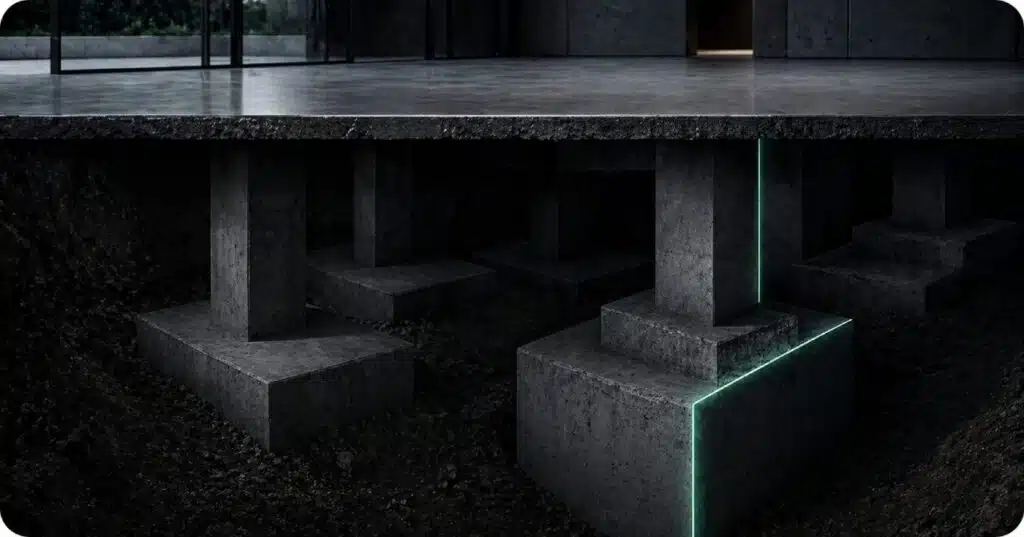
Architecture firms tend to build websites that look excellent and perform terribly in search. The qualities that make an architecture website visually impressive are often the same qualities that make it invisible to Google.
Large, uncompressed images without alt text. JavaScript-rendered pages that crawlers cannot parse, thin service pages with a headline, a hero image, and two sentences of copy. No internal linking between related pages. No schema markup telling Google what the firm does or where it operates.
Here is what a technical SEO audit should cover for an architecture firm:
- Page load speed. Architecture sites are image-heavy by nature. Every image needs compression, lazy loading, and appropriate formatting. A site that takes six seconds to load on mobile loses most visitors before the first project photo renders.
- Mobile responsiveness. More than half of search traffic is mobile. If project galleries break on a phone screen, the site is failing a majority of visitors.
- Crawlability and indexation. Many architecture websites have dozens of portfolio pages indexed but zero service pages, because those service pages were built as visual showcases with no crawlable text.
- Schema markup. LocalBusiness and ProfessionalService schema tell Google where the firm operates and what it does. Without these, the firm is leaving local search visibility on the table.
- Canonical tags. If the firm has service pages that overlap in content, Google needs to know which page is the primary one. Without canonical tags, the pages compete against each other.
- Core Web Vitals. Google measures loading performance, interactivity, and visual stability. Architecture sites with autoplaying video backgrounds and unoptimized fonts routinely fail these metrics.
- Sitemap and robots.txt. Confirm the XML sitemap includes all pages the firm wants indexed. Check robots.txt to make sure critical pages are not accidentally blocked.
These are not glamorous fixes. They are the foundation without which nothing else in an SEO program for architecture firms can work.
SEO Strategy for Architects: Keyword Research That Reflects Real Client Intent
Mapping Keywords to the Firm’s Target Client Type
The most common mistake in keyword research for architecture firms is chasing broad terms.
“Architecture firm” has high search volume and almost zero qualified intent. Ranking for it does very little.
The firms that win in search target keywords that match how their actual clients think.
- A multifamily firm targeting developers should rank for “multifamily architect [city]” and “build-to-rent architecture firm.”
- A healthcare firm should rank for “healthcare architect [state]” and “hospital design architect [city].”
These are specific, they carry buying intent, and they face far less competition.
The keyword strategy for SEO for architecture firms starts with the firm’s ideal client profile. Who are they trying to reach? What does that person search? What project types and geographies matter?
| Firm Type | Example Primary Keywords | Example Secondary Keywords | Content Type |
|---|---|---|---|
| Multifamily / BTR | multifamily architect [city], apartment architect | build-to-rent architecture firm, BTR design | Service pageCase study |
| Institutional / Healthcare | healthcare architect [state], institutional design firm | hospital design architect, academic building firm | Service pageLong-form |
| Commercial / Office | commercial architect [city], office renovation architect | workplace design firm, adaptive reuse architects | Service pageBlog |
| Sustainable / Passive House | passive house architect, LEED certified architect | sustainable architecture firm, net zero design | Blog clusterService page |
Every keyword should trace back to a specific client type, a specific search behavior, and a specific page on the website that earns the click.
Content Marketing for Architects: How Expertise Becomes Visibility
Architecture Blog Strategy: Writing for the Client, Not the Profession
Most architecture firms that blog write about design trends, award wins, and project completions. That content attracts other architects. It does not attract the developers, institutional clients, or homeowners who actually hire architecture firms.
The shift that matters is writing for the client’s questions. A developer considering a multifamily project does not search for “the future of residential design.” They search for “how long does entitlement take in Austin” or “unit mix strategies for build-to-rent.” The content that ranks for these searches is the content that generates inbound leads. It requires the firm to think about what their client needs to know, not what the firm wants to show.
Content strategy builds clusters: a pillar page covering a broad topic supported by posts that address related subtopics in depth. Each supporting post links back to the pillar page and to the firm’s service page. Over time, this cluster signals topical authority to Google, which compounds into higher rankings across the entire group.
A residential firm we work with started publishing neighborhood-specific content about custom home design in specific San Francisco neighborhoods, covering zoning considerations, lot types, and what homeowners should expect from the permitting process. Within six months, the firm moved from referral-only client acquisition to receiving inbound search leads. The content was not flashy. It was specific to a geography and a client type. That specificity is what made content marketing for architects work in practice rather than theory.
The distinction between awareness content and conversion content matters here. A post about “what is passive house design” builds topical authority. A post about “how to choose a passive house architect in Portland” attracts someone ready to hire. Both are necessary. Awareness feeds the search engine. Conversion feeds the pipeline. A complete SEO strategy for architects accounts for both.
Local SEO for Architecture Firms: How Geography Becomes a Growth Lever
Why Marketing for Architecture Firms Must Include Location Signals

Architecture is a local business, even for firms with national practices. The developer searching for “commercial architect Denver” is not going to scroll past the firms that Google confirms are actually in Denver.
The foundation is Google Business Profile optimization. A complete, verified listing with accurate name, address, phone number, service descriptions, project photos, and client reviews gives the firm a chance to appear in the local map pack. That map pack sits above organic results for location-based searches, and for architecture firms, it is often where the first impression happens.
NAP consistency, meaning identical name, address, and phone number across the website, Google listing, LinkedIn, and every directory, matters more than most firms realize. Inconsistency signals to Google that these may be separate businesses, which dilutes authority across all of them.
Location-targeted service pages extend local SEO beyond the firm’s home city. If a firm based in Denver also works in Phoenix and Salt Lake City, creating a service page for each market with city-specific content about local zoning, permitting, and project types signals relevance in each geography. These pages need real content. Swapping the city name on a template does not work.
One residential architecture studio saw a significant and sustained increase in local search impressions after optimizing its Google Business Profile for the first time. The listing had existed but was incomplete. Adding project photos, accurate service categories, and a description written for client search intent made the difference. Local SEO for architecture firms is not complicated. It is just neglected.
What a Working SEO Program for Architecture Firms Actually Looks Like
Architecture Marketing Strategy: Months 1 Through 6
SEO for architecture firms does not produce leads in 30 days. It takes time because it is building an asset, not running a campaign. The asset compounds. The campaign ends.
Here is what a realistic timeline looks like:
- Phase 1: Technical audit and keyword mapping (Month 1). Crawl the site. Fix indexation issues, speed problems, and mobile gaps. Research keywords based on target client type and geography. Map those keywords to existing pages or identify pages that need to be created.
- Phase 2: On-page optimization (Month 2). Rewrite title tags, meta descriptions, and heading structures on service pages. Build internal linking. Create location-specific pages. Add schema markup.
- Phase 3: Content production begins (Months 2 to 3). Publish the first blog posts targeting high-intent keywords. Build the first content cluster around the firm’s primary service area.
- Phase 4: First ranking movements (Months 3 to 4). Pages appear in search results for targeted keywords, typically at positions 15 to 30, and move upward as Google recognizes the site’s growing authority.
- Phase 5: Content compounds (Months 4 to 6). Supporting posts drive authority to pillar pages. The firm begins ranking on page one for specific long-tail keywords. First inbound inquiries from search appear.
- Phase 6: Pipeline impact (Month 6 onward). With optimized service pages, a growing content library, and local SEO signals in place, the firm has a search presence that generates qualified inbound interest on a recurring basis.
The firms that get the best results are the ones that treat SEO as infrastructure, not as a project with a deadline. The content published in month three is still generating traffic in month eighteen.
The Next Step for Firms Ready to Be Found
SEO for architecture firms is not a quick fix. It is a system that, when built correctly, generates qualified inbound interest from the clients a firm actually wants to work with. The firms that invest in it build an asset that compounds over years.
We build SEO and content systems specifically for architecture firms, not for general businesses. The keyword research reflects how developers and institutional clients search. The content strategy speaks to client questions, not industry trends. The technical work accounts for image-heavy, portfolio-driven architecture websites.
If your firm has the work and the reputation but not the organic visibility to match, the problem is solvable. It takes commitment, patience, and specificity. Those are also the qualities that built your practice.See how we approach business development for architecture firms or explore what a lead generation system looks like.
Schedule a Consultation Today.
Frequently Asked Questions
How long does SEO take to produce results for architecture firms?
Most firms see initial ranking improvements between months 3 and 4 of a structured program. Meaningful inbound lead generation typically begins around month 6, when published content compounds and domain authority increases. SEO for architecture firms is a long-term asset, not a short-term channel.
What keywords should architecture firms target?
Target keywords that reflect how your ideal clients actually search. That means project type plus geography: “multifamily architect Chicago,” “healthcare architect New York,” “adaptive reuse design firm Dallas.” Avoid broad terms like “architecture firm” that carry no qualified intent.
Do architecture firms need a blog to rank on Google?
Yes, but only if the blog targets client search intent. A blog covering design trends for peer audiences does not generate client traffic. A blog mapped to client questions, project types, and local markets does.
What is the difference between SEO and content marketing for architects?
SEO is the technical and structural work that makes a site findable: page speed, schema, keyword mapping, internal linking. Content marketing for architects is what gives Google something to rank and gives potential clients a reason to engage. SEO without content stalls. Content without SEO stays invisible.
Can a small architecture firm compete in SEO against larger firms?
Yes. Larger firms often have unfocused strategies that try to rank for everything and rank well for nothing. A smaller firm with precise targeting in a defined niche, strong technical foundations, and consistent content can outrank larger generalist competitors for the searches that generate business.