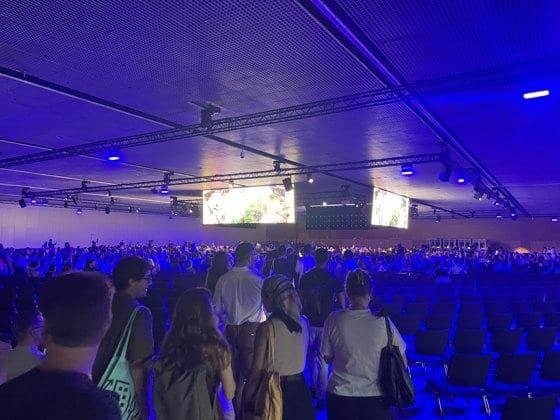
On the 29th of June, we walked into the opening of the UIA World Congress of Architects 2026 in Barcelona. It is the largest gathering in the profession, held in a different city every few years, and in 2026 it landed in Barcelona under one theme: Becoming, architecture for a planet in transition.
Five days, more than ten thousand architects, and almost every firm we admire arriving in the same city at once.
We went for a specific reason. UNCOMMON works on the business side of architecture, the part that decides which firms win the work they want, and we wanted to hear how the profession is thinking about that right now. We also wanted to meet studios in person, record a few conversations, and, for the first time in two years, be in the same room as our own team.
This is what the congress was actually about: the ideas that stuck with us, the atmosphere of the thing, and a few of our own stories from the week.
What the congress was about
The World Congress of Architects is enormous. More than a hundred sessions across eight stages and three venues, spread over five days.
The main venue, the CCIB, sits right on the sea. In the evenings the congress moved out to Les Tres Xemeneies, the three old power-station chimneys on the coast, lit up at dusk, with dinners and talks laid out at their base. The yellow Becoming branding was on every wall.
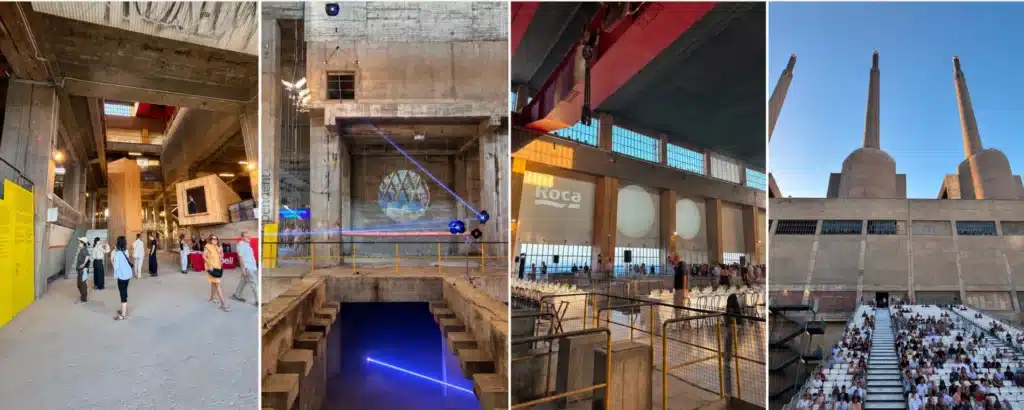
A programme that size is the whole point of the congress, and also its problem. With so many sessions running at once, the hard part is not finding something good. It is choosing.
Before we arrived, we built our own filtered guide to the programme, a founder’s cut for principals whose practice is about impact, reuse, housing and public value, and we shared it for free.
The ideas that stuck
A few threads ran through the week, and the sharpest sessions kept landing on the same point: how a building, a material, or a home gets classified and financed decides what it is worth, often more than the thing itself does.
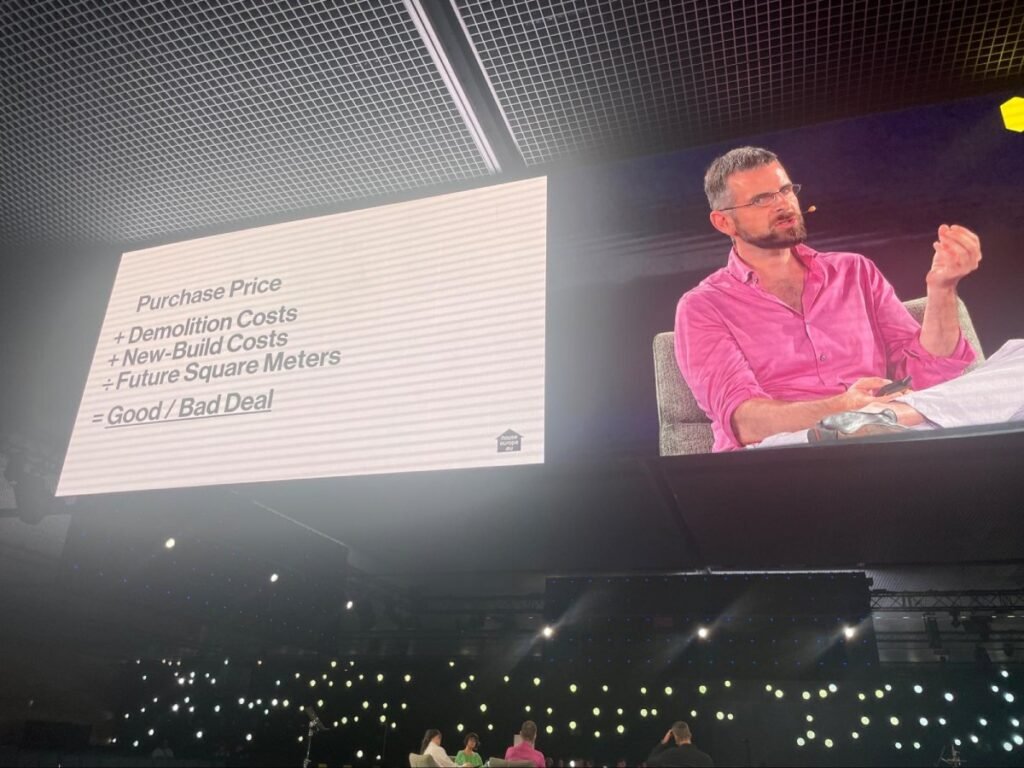
The first day was about circularity, and the best talks treated it as economics rather than materials science. The line that stayed with me was simple: stop demolishing buildings that still work. Someone put up a figure that roughly one building is demolished every minute in Europe.
Lacaton and Vassal, who won the Pritzker for exactly this thinking, have made transformation over demolition the reference point, and one project that came up went from forty flats to eighty on the same structure, with residents staying in their homes through the work, at a fraction of the cost of knocking it down and starting again.
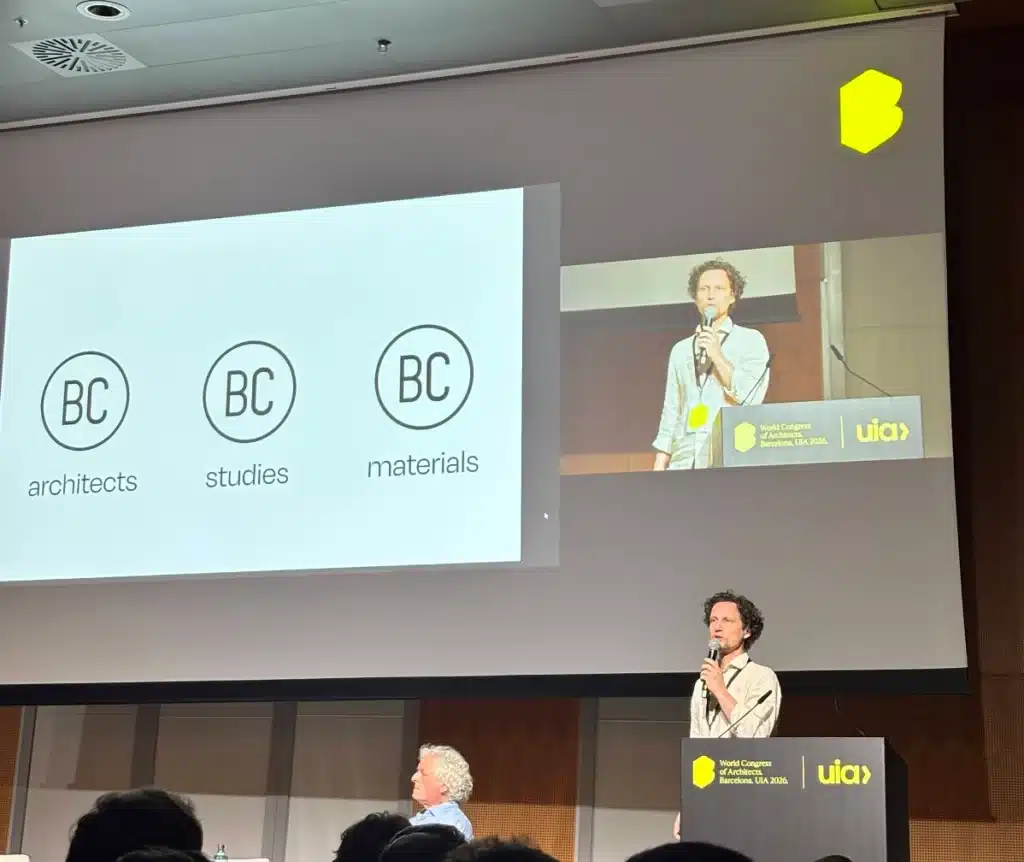
The second day turned to materials and money. BC Architects showed load-bearing walls in multi-storey buildings made from the soil dug out of the site, the same soil that normally leaves as waste. It is essentially quarried clay.
One version is classed as a resource and the other as a disposal cost, and that classification, not the material, sets the economics. Later the economist Mariana Mazzucato separated money made from making things from money made from buying and selling them, and argued that public money and public land can set the terms of what gets built, instead of paying to patch the result after it fails.
By the third day the talk was about who actually does the work, and about AI. A panel on labour asked why architectural work stays so precarious, and part of the answer was the profession’s own story about itself: architecture as a calling rather than a career, and the myth of the lone genius, both of which keep architects out of the rooms where procurement and legislation get written.
Then the theorist Mario Carpo gave the most level-headed take on AI I have heard in a while. Generative AI is an imitation machine, strong at renders and summaries and shaky where precision matters. As it makes beautiful competition imagery cheap, that imagery stops winning work. What wins instead is reputation and relationships.
Meeting the team, finally
There was a personal reason the week mattered to me too. Our team has been remote since day one, spread across three continents.
Ismael works from Canada and moves around Europe. Vitali is in Germany.
I am usually somewhere between Barcelona and Southeast Asia. We built the whole company on calls at odd hours, and the congress was the first time all three of us were in the same city.
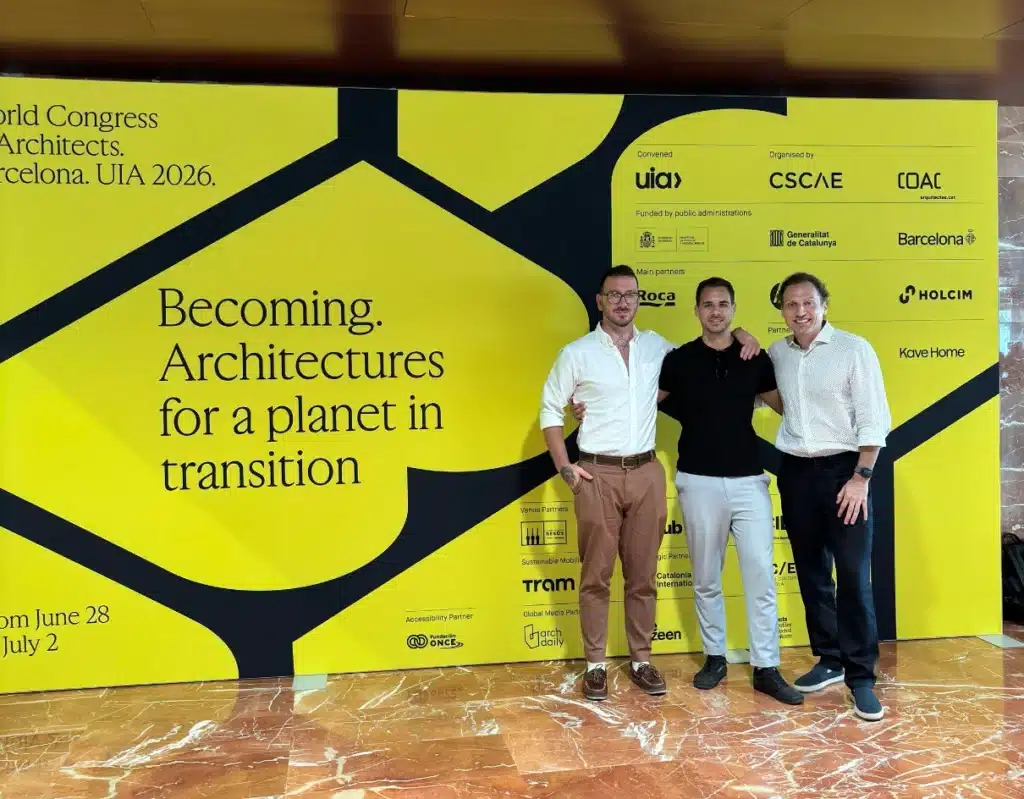
We met that Monday morning outside the opening session. I had talked to these two hundreds of times, and still, walking up to them felt like meeting them for the first time, until about a minute in, when we dropped straight back into the same rhythm we have on every call.
Building a team that pushes the work is one of the best feelings I have had in this project, and I did not expect that morning to arrive so soon.
The studios worth meeting
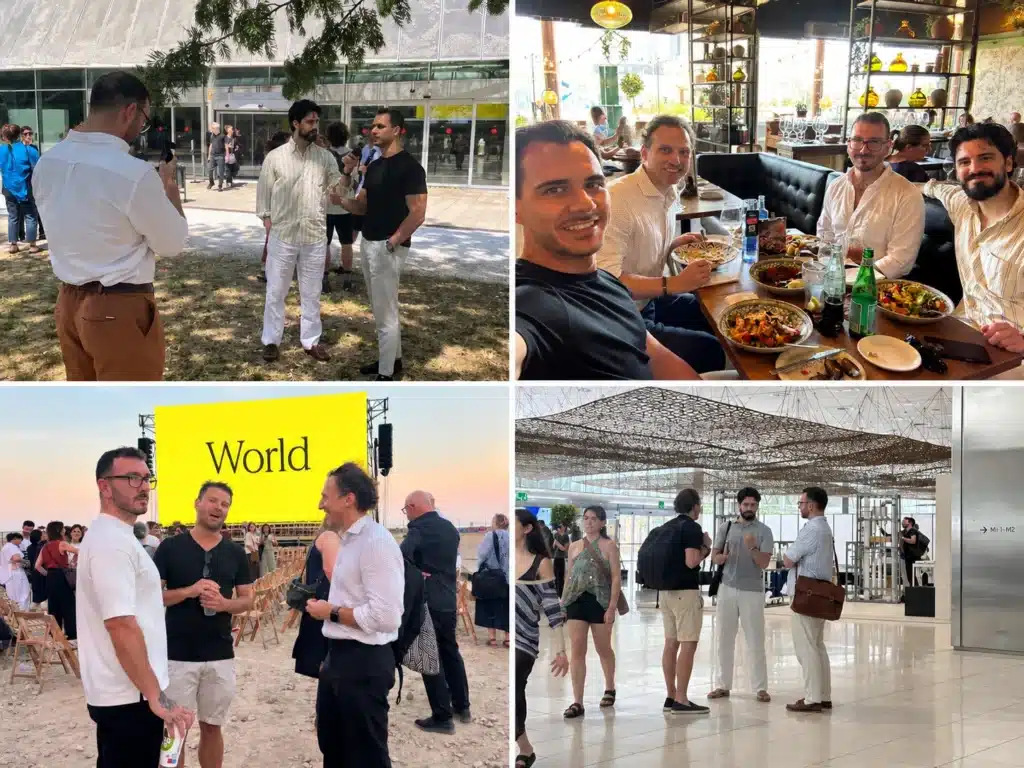
The other reason we came was to record short interviews with founders about the business side of running a studio. We started by trying to catch speakers right after their talks, and after a couple of attempts we understood it was the wrong moment. They were focused on their sessions, as they should have been, so we changed the approach and reached out on LinkedIn to studios that had posted they were at the congress.
That is how we sat down with Sergi Sauras, co-founder of PERF, a young Barcelona studio that has grown fast and won international clients in barely two years. It was the best conversation of the week.
Sergi was generous with all of it, from how they find clients to how they talk about what their work is worth, and he introduced us to a few interesting people around the event, which is its own kind of gift at something this size.
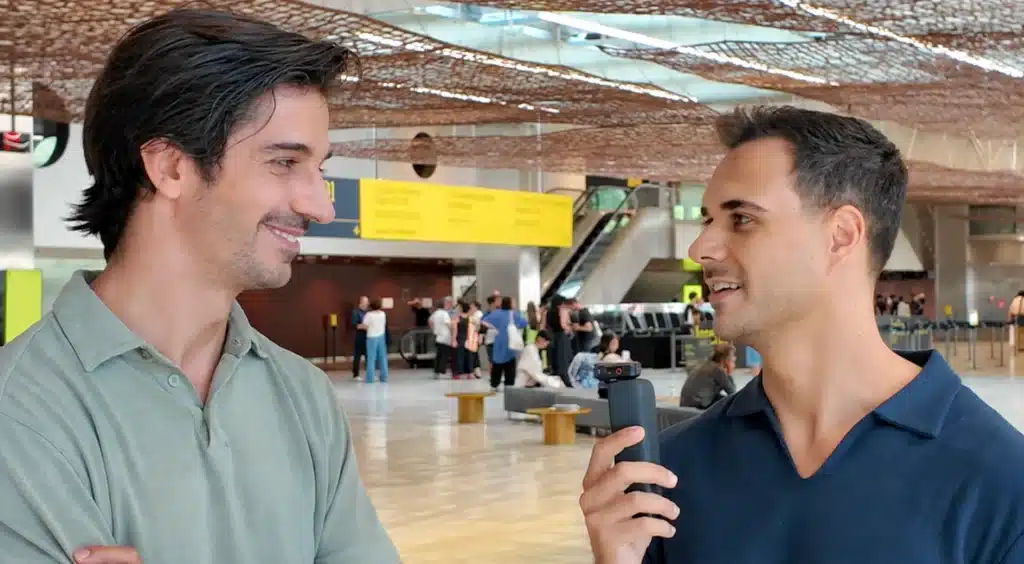
PERF was not the only studio the congress brought closer. We had already been in touch online with the founder of Entropic, here in Barcelona, and the event was the chance to finally meet their business development lead in person.
A few days later we sat down for lunch with the founders themselves. After building most of our relationships through a screen, doing it in person, over a table, is a different thing entirely, and it was a good reminder of why we came.
What we took home
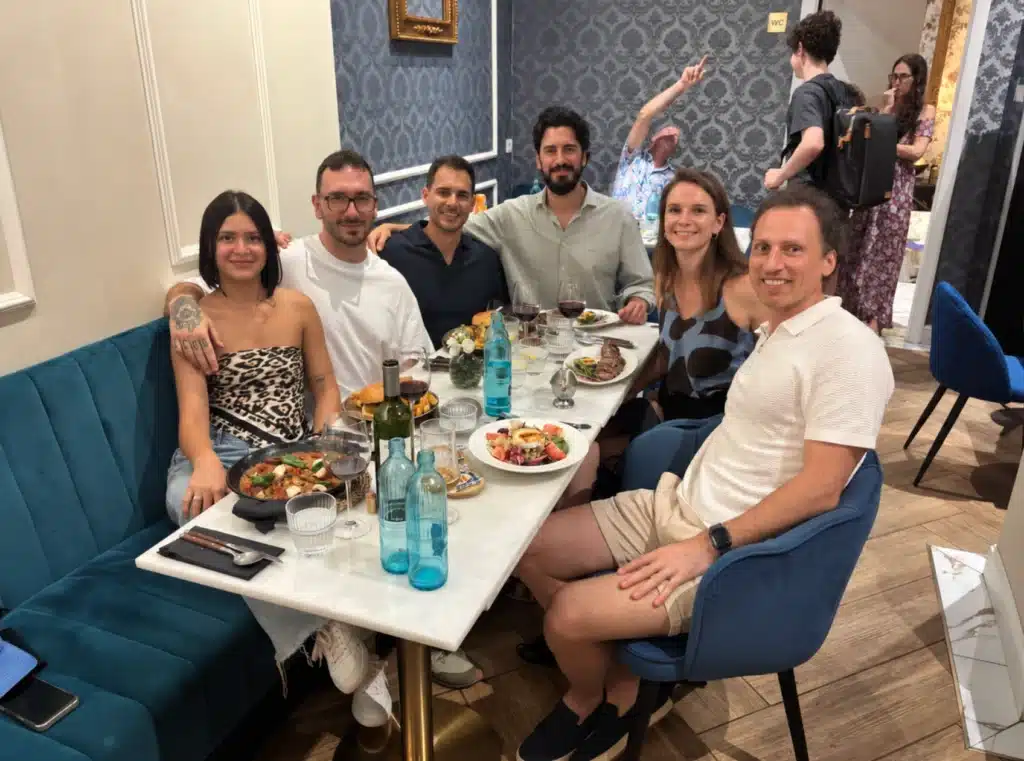
On the last night we all had dinner together, the team, some friends we had made, and their partners. After months of small rectangles on a screen, sitting around one table felt like the point of the whole thing.
I left with one clear thought about the congress itself. For all its brilliance, it leaned heavily on design and concepts, and much more lightly on the business reality that makes architecture happen, the part that lets architects win the work and actually make a living from it. That gap is the reason UNCOMMON exists.
We are writing the full recap of what we learned, session by session, in Shortlisted, our monthly brief for architects. If the business side of this profession is something you think about as much as the design side, that is exactly who we write it for.