


By Estefano Oliveira, founder of UNCOMMON Architects
An architecture firm gets hired off a shortlist. So does the agency that markets one. Here is mine for 2026, grouped by the job you need done:
- UNCOMMON Architects for business development and pipeline.
- Archmark, Third & Arch and DIRT for brand, positioning and messaging.
- UpSpring and Reputation Ink for PR and earned visibility.
- Nover Marketing, Siana Marketing and Smartegies for full-service marketing across AEC.
I run UNCOMMON, which is first on a list I wrote, so read it knowing that. Here is what I think you get in exchange.
The firms I see wasting money on marketing are usually not the ones who picked a bad agency. They picked a good agency for a problem it does not solve. A firm with a full pipeline and a weak brand needs something completely different from a firm with beautiful work and nobody calling, and both of them get sold the same retainer.
I do not believe one solution fits every firm. Being inside this category is what makes the criteria useful, because I know what these agencies are good at from competing with them, and from losing to them. So the list is built around what you need, not around who I would like you to call.
The rest of this article shows how I grouped it, what each agency does, and how to work out which one fits the gap your firm has right now.
Why architecture firms bring in a growth partner
Architecture is bought on trust by a small number of people. A multifamily developer shortlists the two or three firms it already believes can carry a project through entitlement without breaking the pro forma.
A school district runs formal procurement and scores what a committee can verify. A homeowner calls the architect their realtor has mentioned twice. In each case the decision starts forming well before any RFP, in conversations the firm either was or was not part of.
Most principals know this. What they lack is time and infrastructure. At a small studio, the principal is the business development department and also the person finishing drawings at 11pm. At a mid-size practice, BD sits with a partner who carries a full project load, and the pipeline lives in that partner’s head. Larger firms have marketing staff and a BD habit that has been reactive for decades, because referrals used to be enough on their own.
A growth partner builds and runs the system the firm cannot staff itself: who to talk to, what to say, what to publish, and what a stranger finds when they check the firm out. The wider method is covered in our guide to marketing for architecture firms.
This article is about choosing the people to run it.
How to choose a marketing agency for architects
Every agency below is credible. The differences show up in four places, and in one question almost nobody answers well.
Fluency in who commissions your work
“Architects” is a profession, and every firm in it sells to a different market. A firm selling to developers needs a partner who can talk density, entitlement risk, and whether the deal pencils. A firm selling to school districts needs one who understands procurement committees and sector track records.
A firm designing $5M custom homes needs one who knows the realtor’s second mention carries more weight than any campaign. Ask a prospective agency who your last three clients were, who signed those contracts, and what those people read.
An agency that describes “your audience” in the singular has never sat in the rooms where your projects are won. Of the four differences, this is the one I would not compromise on. The rest an agency can learn on your time.
Who does the work after the contract is signed
Specialist agencies in this niche are small, and the person who sold you is often the reason you bought. Ask who writes the outreach, who drafts the content, who picks up the phone when a campaign stalls, and how much of the founder you get after month one.
There is no wrong answer here, but there are surprises, and a first call is the cheapest place to find them.
My own bias here: I would rather work with a small team where the founder still touches the work than a larger one where they do not.
What counts as a result
Impressions are the easiest number to grow and the least connected to signed work. The measures that track the business sit further down:
- Qualified conversations with people who commission buildings,
- Shortlist appearances,
- Signed contracts, and
- Referral relationships that quietly send work sideways.
Ask each agency for a case study matched to your sector and your scale, then read what it counts. A 50-person multifamily practice and a six-person residential studio should never be shown the same proof.
Here is how that looks in our own work with a multifamily firm; hold every agency on this list, including us, to that standard of specificity. If an agency cannot produce that case study, it usually is not hiding it. It has not done the work in your sector yet, and you would be the first.
Whether they understand how firms surface in AI search
A growing share of buyers now asks an AI which firms to consider before they ever type a name into Google, and the same is happening one level up when firms shop for agencies.
Getting cited in those answers rewards what good marketing already rewarded:
- Real expertise on indexable pages,
- Direct answers to real questions, and
- A name that appears on third-party sites beyond your own.
Ask an agency how they would get your firm mentioned in an AI answer. Be careful with anyone whose plan centers on special AI files or markup; the writing and the third-party presence do the work.
The shortcut version of this gets sold hard at the moment, and I would treat any plan built mostly on markup as a sign the agency has not tested it.
The competitor question, and the answer that worked
Every agency on this list serves your industry, which raises the selection worry few buyers ask out loud:
“if they are good at this, what stops your competitors from hiring them next?”
Earlier this year, a large cultural architecture practice, 300-plus people, asked us exactly that during a proposal process. My first instinct was to describe a policy. What I said instead was specific: I named an existing client, a firm in a different geography with a different material specialism, and walked through why no overlap between the two was possible. The consultant who raised the question accepted the answer and moved on.
That firm declined our proposal in the end, so treat this as a conversation I learned from rather than a win. What it taught me holds on both sides of the table. An exclusivity policy invites cross-examination, because a policy can be worded around. A named example closes the question.
Ask every agency you shortlist for the named example.
How I ordered this list
Nine agencies, four categories, sorted by the problem you are actually trying to solve. I lead with the job most firms are carrying when they come to us, which is booked work.
UNCOMMON leads the category it was built for, and you should weigh the list accordingly. What I offer in return is directness about fit. If your gap is brand, call Archmark, Third & Arch or DIRT before you call me. If your gap is press, UpSpring and Reputation Ink do work we do not sell. If you want one generalist partner across everything, the fourth category is yours and I am not the right call.
No agency paid to appear here, and every fact in the profiles below is checkable on the agency’s own site or in its published coverage.
The nine agencies at a glance
Grouped by the job you need done. We run UNCOMMON, so weigh the list accordingly.
Best for business development and pipeline
This category is the shortest on the list, and that is a fair picture of the market. Most agencies serving architecture lead with brand, PR, or websites. Running outbound business development as the core product, named accounts, outreach in the principals’ own voices, a pipeline that lives in a CRM instead of a partner’s memory, is work almost nobody in the category sells.
What a business development engagement involves is closer to building a sales function than to managing campaigns, which is probably why the field is thin.
UNCOMMON Architects
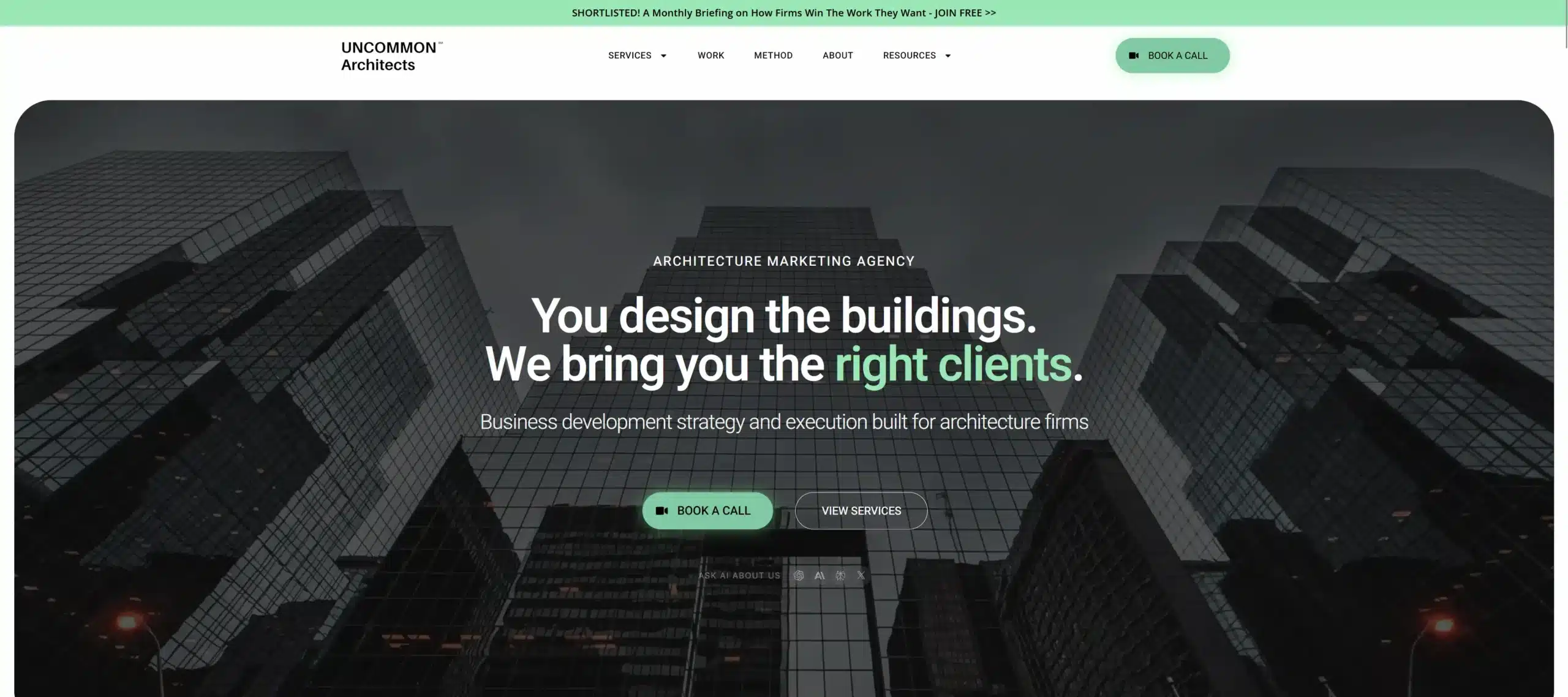
A remote, internationally operating growth and marketing partner working only with architecture and design firms, founded by an architect who moved into marketing and business strategy.
The engagement runs business development and marketing as one program:
- Spotting opportunities in the market,
- Building target relationships with the people who commission the work,
- Authority content published under the principals’ own names,
- SEO, local search and visibility in AI answers,
- Lead generation,
- Website design, and
- Branding and positioning, built from one strategy.
Fits firms that want a single partner accountable for growth and whose principals will stay involved, since the program borrows their voice and about an hour of their week.
The wrong fit for a firm shopping for a one-off brand refresh or standalone ad management, because we do not sell either on its own.
Best for brand, positioning and messaging
When the built work is strong, and the story could belong to anyone, these are the specialists.
Archmark

An architecture-only branding and marketing agency in Estero, Florida, founded in 2016 by Bryon and Kellie McCartney. The mix is brand strategy, websites, and SEO, paired with something few agencies offer: coaching, so the principal learns the marketing while it gets done.
Bryon is a certified StoryBrand coach, a regular across the small-firm ecosystem around EntreArchitect and AIA chapters, and the team has reviewed several hundred architecture firm websites in its research. Fits small firms whose principal wants a clearer message and a working website, and wants to understand both.
Third & Arch
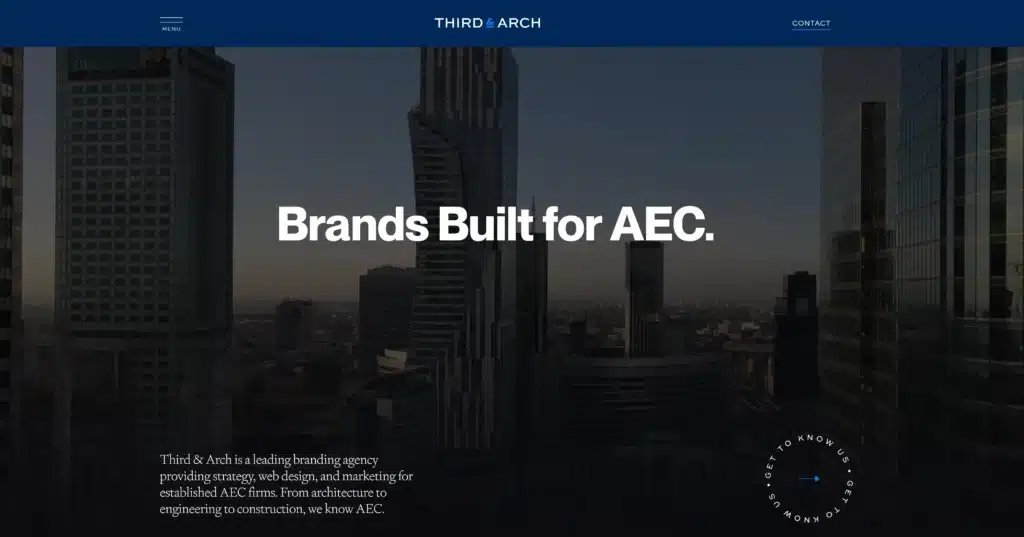
A Philadelphia branding agency for AEC, launched in 2024 as the dedicated arm of Push10, a brand and web studio founded in 2010. The offer is identity and website handled together by one team, so the rebrand never arrives six months ahead of a site that contradicts it.
Fits firms heading into a name change, a merger, or a repositioning who want the visual identity and the web build under one roof.
DIRT
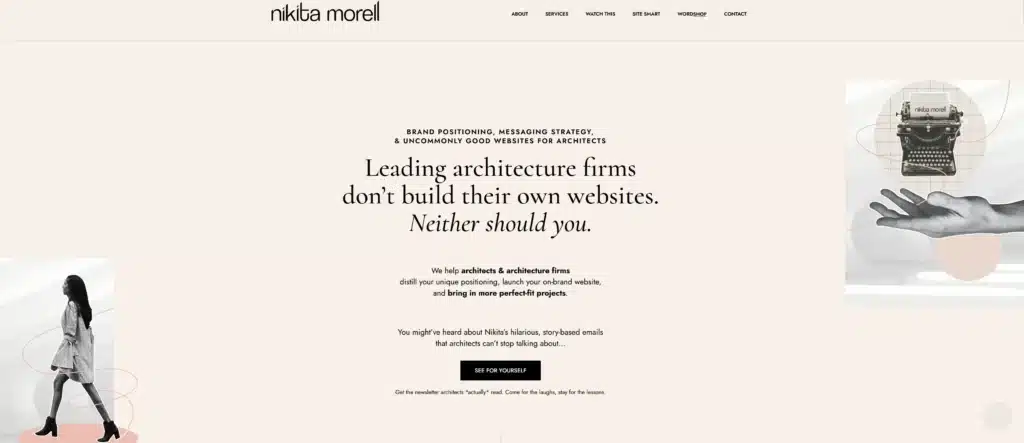
A strategy-led studio that works messaging first: positioning, brand story and copy come before any visual identity, on the argument that a logo cannot fix a firm nobody can describe.
DIRT was founded by Nikita Morell, a copywriter who spent over a decade writing brand messaging exclusively for architects, and its current roster leans toward AEC software and technology companies, with architect-specific messaging running through her own studio.
Fits firms and AEC companies whose problem is the words: the portfolio holds up, and the About page could be swapped with a competitor’s without anyone noticing.
Best for PR, media and earned visibility
Press does a different job from pipeline. It compounds, it shortens sales conversations, and the third-party mentions it produces are exactly what AI systems lean on when they assemble an answer.
UpSpring
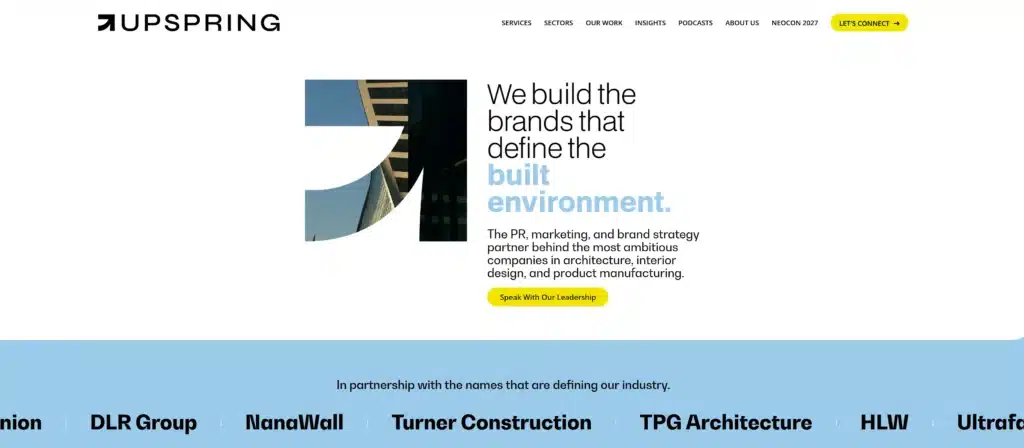
A New York PR and marketing agency for the built environment, founded in 2009, women-owned, and led by CEO Tiffany Rafii and President Sarah Terzic. UpSpring works with architecture firms, interior design practices, and building-product manufacturers, and its core trade is placement: principals and projects into publications like Architectural Digest, Dezeen, and The Wall Street Journal, plus awards and speaking.
The agency frames outcomes around specification and selection, which is the right frame for firms whose buyers read the trades. Fits established firms with built work worth covering and a sales cycle that press can shorten.
Reputation Ink
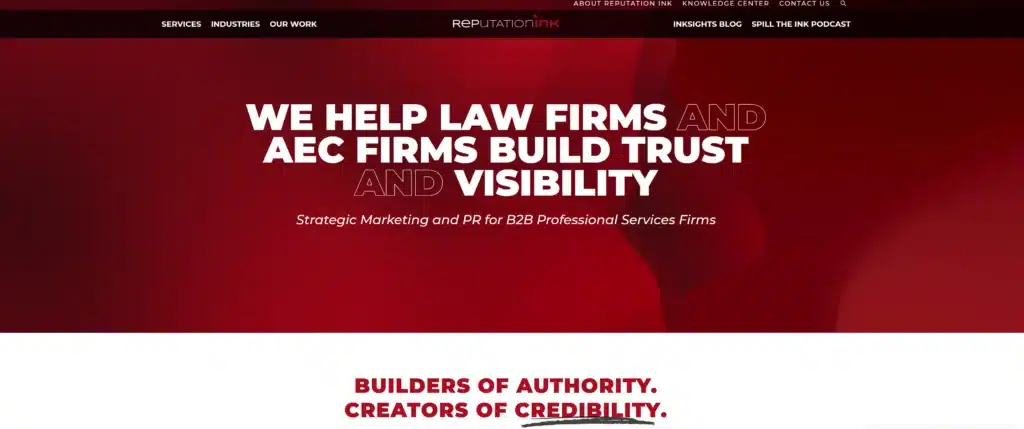
A Jacksonville PR and content agency for expertise-driven industries, with AEC as a core practice alongside legal and complex B2B. The work is media relations, executive thought leadership, awards, and long-form content, led by Michelle Calcote King, who hosts the agency’s Spill the Ink podcast.
Fits firms whose growth depends on being the recognized expert in a sector, with principals willing to put their names and opinions in public.
Best for full-service marketing across AEC
Full-service architecture marketing firms trade depth in one channel for a single accountable partner across many. That trade makes sense more often than specialists like me admit.
Nover Marketing

A Colorado agency founded in 2018 by Tiffany Quillan, serving architecture, engineering, construction, and manufacturing companies. The scope runs across branding and identity, digital marketing, content, and events for organizations that want one AEC-fluent partner handling several channels at once.
Fits firms consolidating scattered marketing vendors into a single relationship.
Siana Marketing
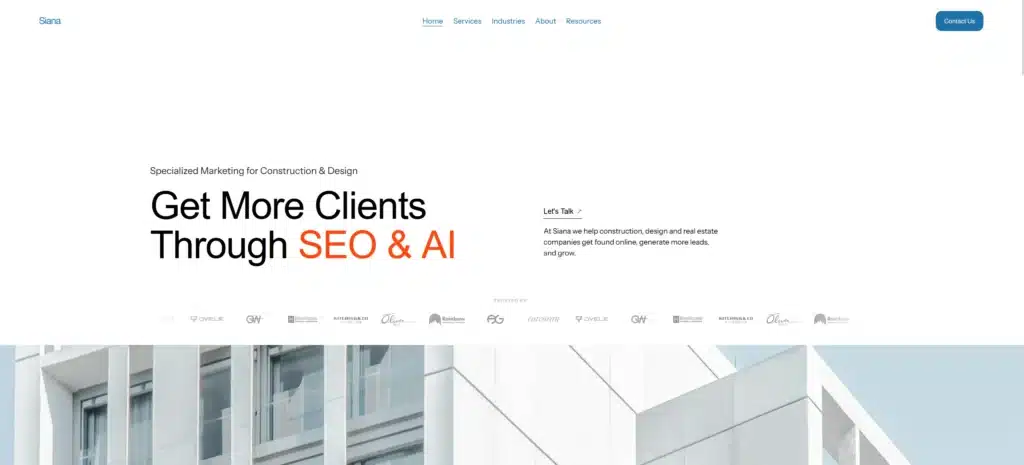
A Miami agency founded in 2022 by Daniela Pedroza, a trained architect with a Master of Architecture from UC Berkeley who worked at HENN before moving into marketing. The center of gravity is search: SEO and AI-search visibility for construction, architecture, engineering, and real estate companies, wrapped with content, web, and social.
Siana publishes its own ranking of agencies in this niche using a stated six-factor scoring method applied across 49 agencies, which at minimum shows its work. Fits firms whose problem is being found in Google and in AI answers, and who want a practitioner-architect’s read on how buyers search.
Smartegies
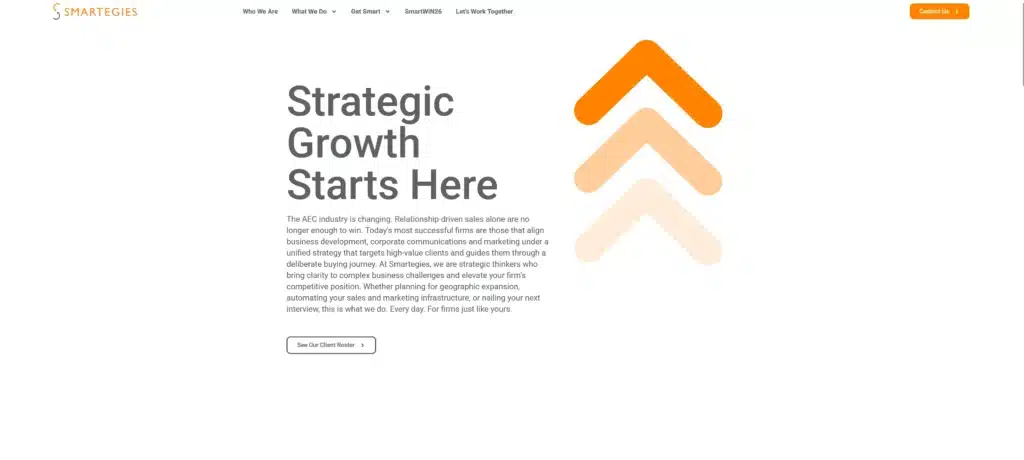
An Atlanta consultancy founded in 2008 by Judy Sparks, a former chief marketing officer of an international design-build firm. Smartegies is AEC-exclusive strategy work: fractional CMO engagements, brand and pursuit strategy, marketing team training, and the alignment of BD and marketing around enterprise pursuits, organized through its Scalable 6 framework.
Sparks co-developed the construction marketing curriculum at Georgia Tech, and the client roster includes organizations the size of Kimley-Horn and Balfour Beatty.
Fits large firms with a marketing team that needs direction and seven-figure pursuits to organize; a five-person studio would be buying more strategy than it could execute.
Business development, SEO or PR: which comes first
It depends on the constraint that is binding. If nobody inside the firm can say in one sentence who the firm is for and why that buyer should care, positioning comes first, because outreach and search both amplify whatever the current message is.
If the message is clear and the calendar is emptying, business development moves fastest: outreach opens qualified conversations within weeks, and the full sequence of business development for architecture firms can run alongside everything else.
SEO is the longest game and now pays twice, because AI answers draw on the same indexed pages that rankings do; what moves the needle in SEO for architecture firms is a shorter list than most agencies imply. PR compounds on top of a clear position, and it is the channel that puts a firm’s name on the third-party sites AI systems trust.
One caution from our own engagements: firms that rush past the first 90 days of setup, positioning, message, profiles, and CRM see slower traction in every channel afterward. On a limited budget, running one channel well beats starting three at once.
Matching the agency to your gap
If your firm’s problem is that nobody can describe it, start in the brand category. If the work is strong and invisible to the people who commission it, start with PR.
If the problem is the calendar, the pipeline, and the next twelve months of fees, that is the job UNCOMMON was built for, and the honest first step is a conversation about whether our growth partnership for architecture firms fits where your firm is, which is also how you find out quickly if it does not.
If you want the fuller picture before talking to anyone, how architecture firms get clients, from positioning to pipeline, is the place to start.
FAQs
What does an architecture marketing agency do?
It depends on which category the agency sits in, which is why the label alone tells you little. A business development agency builds and runs outbound: named-account lists, outreach, authority content, pipeline. A brand agency handles positioning, messaging, identity and the website. A PR agency earns placements, awards and speaking slots. A full-service agency runs several of those under one retainer. The grouping in this article matters more than the word “marketing” on anyone’s homepage.
How is marketing for architecture firms different from other B2B marketing?
The buying unit is a committee or a long relationship, the cycle runs quarters to years, and the buyer varies wildly from firm to firm: a developer weighing a pro forma, a procurement committee scoring credentials, a homeowner deciding on trust. A large share of a typical firm’s work also arrives through people who never sign the contract, brokers, contractors, engineers, and past clients. Generic B2B funnels are built for volume; an architecture practice runs on a few dozen relationships a year, so the marketing has to aim at shortlists and referral networks, where a form fill was never the goal.
How much does an architecture marketing agency cost?
Published pricing is rare in this niche. From our own sales conversations across roughly eight prospective firms in the first half of 2026, $5,000 a month settled as the reference price for a specialist growth engagement, with firms under ten people negotiating hard toward $3,500. Fixed-scope projects like a rebrand or a website are priced separately by scope. Whatever number you hear, ask early what it buys in hours and deliverables, and ask which parts continue if the retainer pauses.
How long does architecture marketing take to work?
Longer than any agency’s homepage implies, ours included. Across our client base, the first 90 days go to positioning, message, and infrastructure, and the following months go to conversations. No client of ours has signed a project inside the first four to six months of a program, and every one of them signed work that traced back to relationships built between months six and eighteen. An agency promising signed projects in 30 days is describing a different industry.
Should we hire in-house or bring in a specialist agency?
A good in-house marketer beats a mediocre agency on consistency, proposal support, and institutional memory, and many mid-size firms should have one. The case for a specialist is pattern exposure and infrastructure: an agency working across many firms has watched the same outreach message fail for three clients before yours, and it arrives with the systems already built. Plenty of firms run both, in-house for pursuits and proposals, a partner for outbound, search, and content. The wrong version is hiring a junior marketer alone and expecting a pipeline.
When should an architecture firm hire a marketing agency?
When three things are true. The firm has built something real to market: a portfolio, a track record, a point of view. The principals can give the work their voice and roughly an hour a week. And the business is stable enough to think past next quarter, because this work compounds and the interesting part starts around month four. A firm that needs three projects by Friday needs a different kind of help, and an honest agency says so on the first call.