
Growing an architecture firm comes down to 3 decisions. Which 1 or 2 types of clients you want more of. Who decides, who refers, and who influences in their projects. And which 20% of your business development effort wins most of your work, so you can move the rest of your hours there.
Most firms that stop growing are busy. The schedule’s full, the team’s booked, and the work still comes from the same clients and partner contacts as 5 years ago. Across the firms we work with, new relationships turn into real conversations within 3 to 6 months and into projects between months 6 and 18.
Who decides and who refers changes completely between a developer, a retail chain, a university, a homeowner, and a hotel operator. So the sections below take each one separately: who to know, who sends the work, and the few moves that pay off, with numbers from our own client programs.
Why established architecture firms stop growing
From the inside, a plateaued firm looks healthy. Every project manager is booked, fees are coming in, and the partners are too busy to ask why revenue has been flat for 3 years.
The same 3 things usually sit underneath. Most fees come from clients the firm already has. New relationships arrive only through the founding partners, whose contacts are getting closer to retirement every year. And the team spends its hours on project types the firm meant to leave behind, because those projects pay and nothing better is waiting.
We group the causes into 3 stages, and the order matters.
| Stage | The question | What it looks like when it is missing |
|---|---|---|
| Plan | Who is the firm for, and can that client see why it is different? | Proposals talk about design philosophy while the client is weighing schedule, risk and cost |
| Build | Can a buyer verify it in five minutes? | The website and case studies are written for other architects |
| Share | Who is building relationships with the right people every week? | The pipeline lives in two partners’ heads |
Skipping a stage is the most common mistake we see. A new website won’t help while it still speaks to architects, and outreach won’t help before the firm knows who it’s reaching out to. If positioning is where you are stuck, start with our guide to architecture firm branding and positioning.
If you’re not sure which stage is holding your firm back, the growth plateau diagnostic scores your firm against the 8 patterns we see most often. It takes about 2 minutes.
The 80/20 rule for architecture firm growth
In most firms, a small share of clients produces most of the fees, a handful of contacts produce most of the introductions, and 1 or 2 channels produce most of the meetings. Growth comes from finding those few and moving hours toward them.
MEEKS + Partners, a 50-person, second-generation multifamily firm working across the Sun Belt and Midwest, makes this explicit. It splits its business development effort across 4 tiers of developers:
| Developer tier | Share of BD effort | Why |
|---|---|---|
| National institutional developers | 10% | Selection takes 60 to 180 days. High lifetime value, hard to enter |
| Regional growth developers | 30% | Several projects per relationship, selection in 30 to 90 days |
| Emerging, single-market developers | 40% | Fastest cycles (1 to 4 weeks), the founder chooses the architect directly, highest conversion |
| Build-to-rent and new entrants | 20% | Selection in 2 to 8 weeks, variable fit |
The biggest names get the smallest share. Effort follows how fast a tier converts and how well it fits the firm, and the national developers get patient, steady attention in the background.
Map the deal: who decides, who refers, and who influences
Every project an architect wins has 3 kinds of people around it.
The decision-maker signs the fee. This is your ideal client: a development manager, a facilities director, a homeowner.
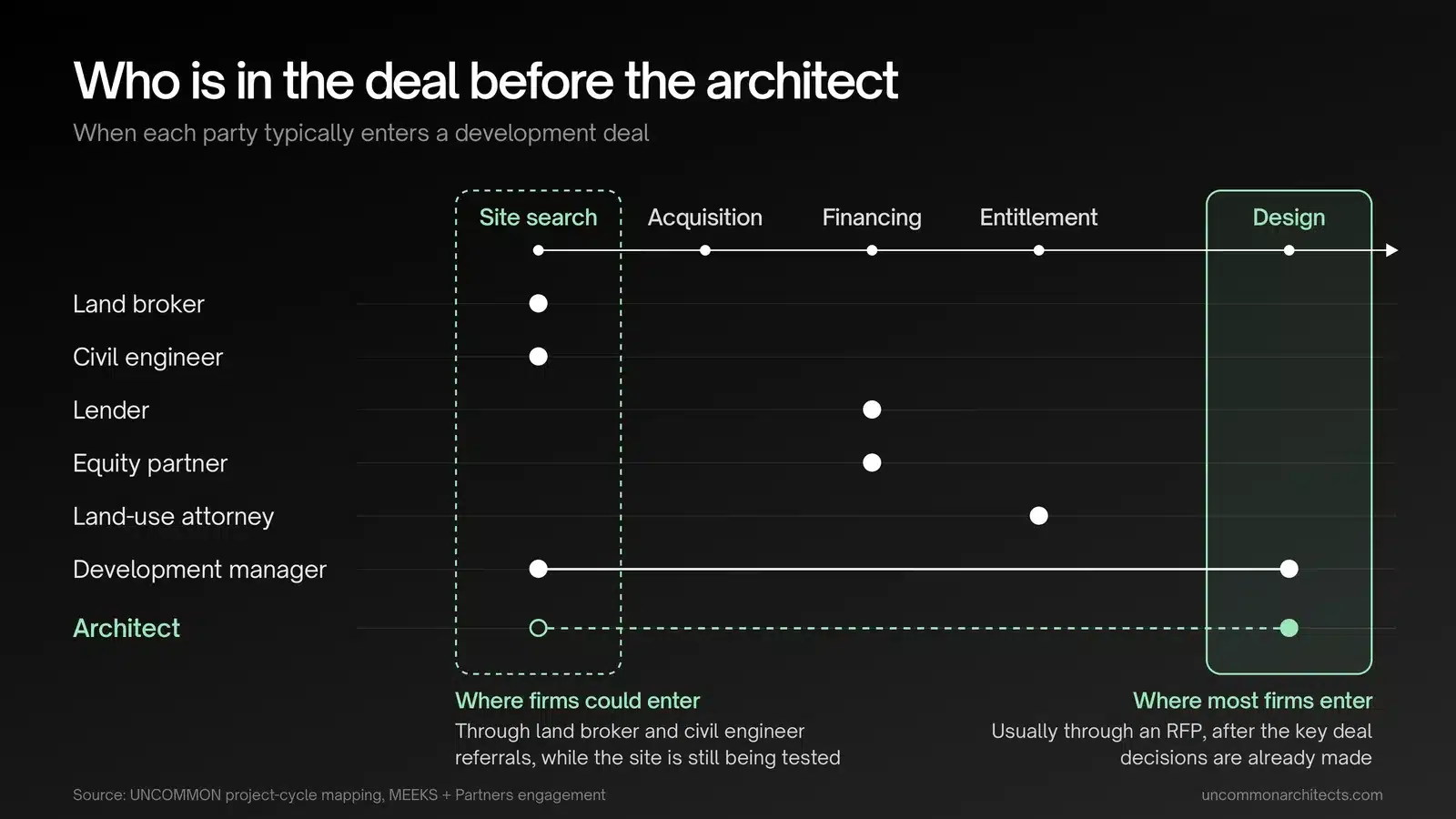
The referral partner is in front of that client before an architect is hired, and doesn’t compete for the same scope. A civil engineer testing a site, a broker selling the land, a realtor helping a family buy a lot.
The deal influencer shapes the shortlist without signing anything: the lender or equity partner, the development manager who forwards your material up to leadership, the committee that scores the RFP.
The second and third groups are where the 20% usually sits, and most firms spend almost no time on them.
Who decides, who refers and who influences, by client type
Development managers, heads of acquisition
Civil engineers, land brokers, land-use attorneys, contractors
Lenders and equity partners, managers forwarding your work upward
Referral partners plus a named list of 25 to 50 developers
Corporate real estate and expansion leads
Commercial and tenant-rep brokers, contractors
Landlords, owner’s project managers, brand teams
Brokers, and one capability document per vertical
Facilities and capital planning, procurement
Owner’s reps, sector engineers, partner firms on joint pursuits
Committees, boards, end users
Being known before the RFP is issued
Homeowners
Realtors, builders, interior designers, landscape architects
Family, the builder’s opinion
Local search plus a realtor and builder network
Operators, owners, investors
Larger architecture firms needing a specialist partner
Brand operators, investors
Founder visibility and patient relationships
Based on UNCOMMON client programs with architecture firms, 2025 to 2026. Developer selection times by tier: 1 to 4 weeks (emerging), 30 to 90 days (regional), 60 to 180 days (national).
If your firm only does one kind of work, skip to its section. For turning those relationships into signed work, see how to get architecture clients.
How to grow with each type of client
Real estate developers: multifamily, mixed-use and build-to-rent
What they care about. Density, entitlement risk, constructability, schedule, and whether the site pencils. Developers check LinkedIn every day to follow projects, people, and the market. A post about a design award reaches other architects. A post about units per acre or what a density change did to a pro forma reaches the people who approve fees.
Who to know. Civil engineers are often the first consultants a developer calls when testing a site, and they recommend architects they trust. Land brokers see the deal before anyone else, and the ones who represent developers in acquisitions regularly bring architects in to test-fit a site. Land-use attorneys refer architects who hand them clean entitlement packages. Contractors who’ve built with you will describe you to their clients as “an architect we can actually build with.” Aim for working relationships with 10 to 15 civil engineering and land brokerage firms in your market.
The 80/20 moves. Keep a named list of 25 to 50 developers who build your product type in your region, researched for their pipeline, recent land purchases and decision-makers. Reach out when something changes: a developer entering your market, a fundraising announcement, a new development hire, or the window after site acquisition and before entitlement. And build one piece of proof in their terms.
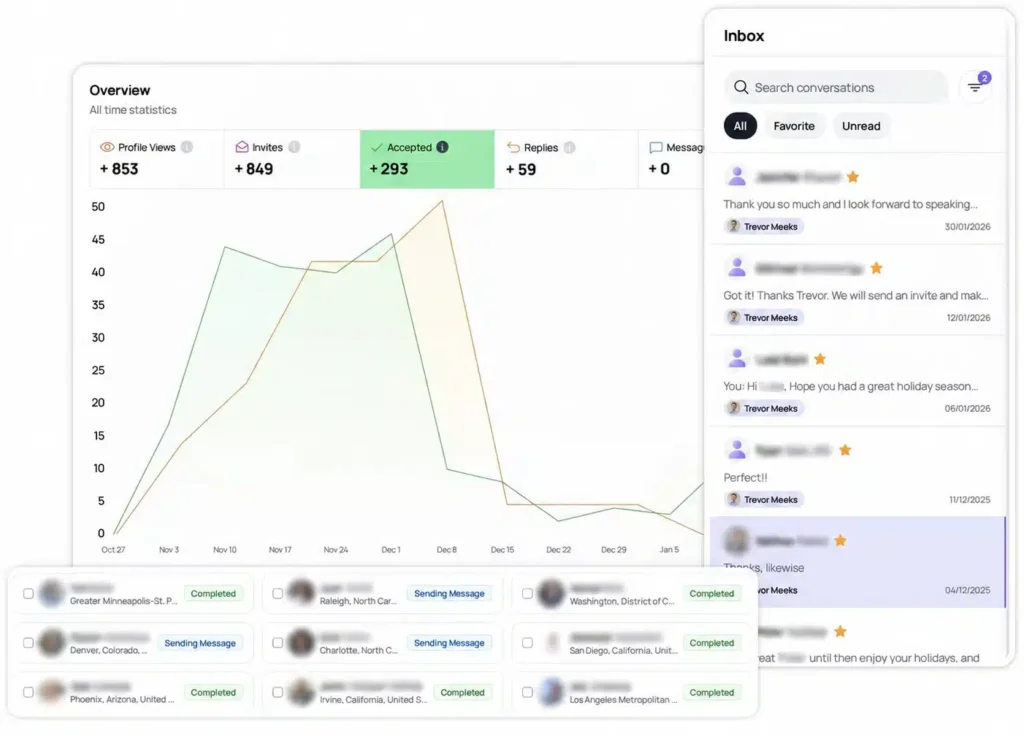
Proof. MEEKS built that proof in 48 hours: a density study developers used at site acquisition to test whether a project was viable. In the first 4 months of its program, including ramp-up, LinkedIn outreach and content written in the partners’ voice produced 28 executive conversations at developer organizations and 9 qualified meetings with senior development leads at national multifamily firms. Connection acceptance ran at 37.3%, and the partners’ audience grew from 243 to 796 industry connections.
Then a national multifamily developer approached the firm with no outreach involved, after seeing its posts and density data, and began sending sites to evaluate. One of their team put it this way:
“It’s all your stuff getting up everywhere. Who are you guys?”
The MEEKS + Partners case study has the full program. For more depth on this segment, read how architecture firms build relationships with developers or download our developer relationship guide.
Commercial, corporate, and retail rollout clients
What they care about. Program consistency, rollout speed, predictable cost, brand standards, and how quickly permits come through.
Who to know. Commercial and tenant-rep brokers, contractors, and the owner’s project managers. Brokers who know a firm personally become steady referral sources, and cold outreach to brokers brings less each round. The ask that tends to open the door: “Can we grab coffee and you tell us about your pipeline?”
The 80/20 moves. One capability document and one proof point per vertical. A firm doing retail, clinics, and hospitality needs 3 short documents, each in that buyer’s language. HHA Architects, a multi-disciplinary firm we work with in New York and California, runs separate outreach for retail, hospitality, health and wellness, and clinics for exactly this reason.
Proof. TECHNE Architecture is about 10 people in California, with 350+ completed commercial and mixed-use projects. Its edge is speed and certainty through California entitlement and fire-zone compliance, at close to twice the industry average for permit approvals. Its messages to developers and brokers talked about entitlement timelines, because for a developer, a faster permit means less time carrying the site. In 5 months, including ramp-up, that produced 67 executive conversations with commercial real estate decision-makers and brokers, 21 qualified opportunities and a 45% positive reply rate. The TECHNE case study has the setup.
Institutional and public clients
What they care about. Procurement compliance, a track record in the sector, how you manage stakeholders, and a process they can defend to a board. One studio we work with found its institutional clients cared most about whether a building would still matter in 10 years, and the sustainability credentials the firm led with rarely came up. Ask before you assume.
Who to know. Owner’s representatives, engineers who work in the sector, and other architecture firms you could partner with on joint pursuits.
The 80/20 moves. Be known before the RFP is issued. Join 1 committee in the sector’s associations. A committee that meets every month builds relationships with the same people, month after month. Build credentials in one sector before spreading into a second.
We don’t have published numbers for this segment yet, so this section is shorter. The patterns above come from our client work and conversations.
Custom residential
What they care about. Trust, taste, how well you communicate, honesty about budget, and what the process will feel like for their family.
Who to know. Residential firms run on realtors and builders, then interior designers and landscape architects. Commercial firms run on brokers and engineers. Very few residential studios build this network on purpose.
The 80/20 moves. Be findable. Homeowners search, and most architects don’t show up. And start with the network you already have: email your past clients and your realtor contacts before spending anything on cold outreach.
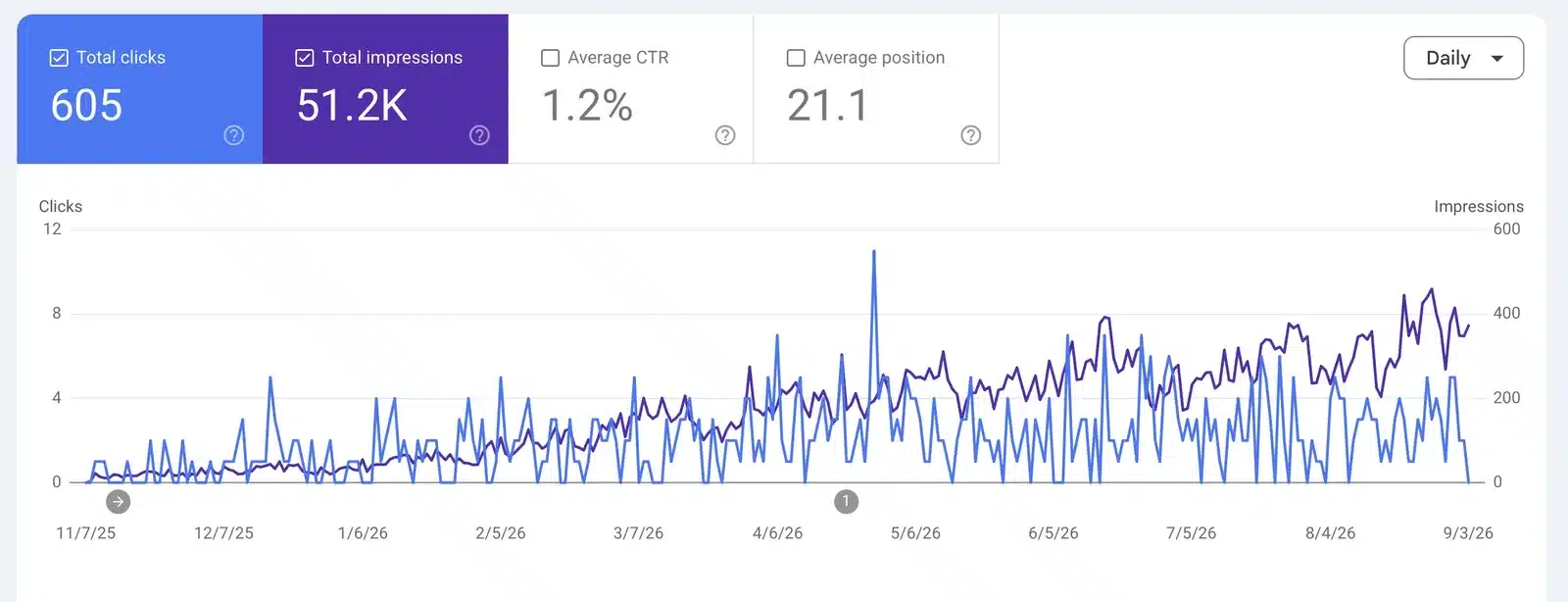
Proof. Studio Couture designs $5M to $10M custom homes across Marin County. We rebuilt its website on a new domain and ran local SEO alongside LinkedIn outreach. Within 6 months, the new domain ranked first on Google for a local architect search, with 8 keywords on page one, and the studio had 4 new opportunities and 1 closed project.
Hospitality
What they care about. Guest experience, return per key, how the property stands apart, and whether you can deliver in remote or difficult places.
Who to know. Operators, owners and investors, plus larger architecture firms that need a specialist partner for competitions and concept work. A larger firm that brings you in once can become your most reliable source of referrals.
The 80/20 moves. Put the founder in front of decision-makers. Operators and investors need to see the work in their terms: occupancy, guest experience, return per key. Expect relationships to take 6 to 36 months to convert, and judge early outreach by the warm conversations it opens.
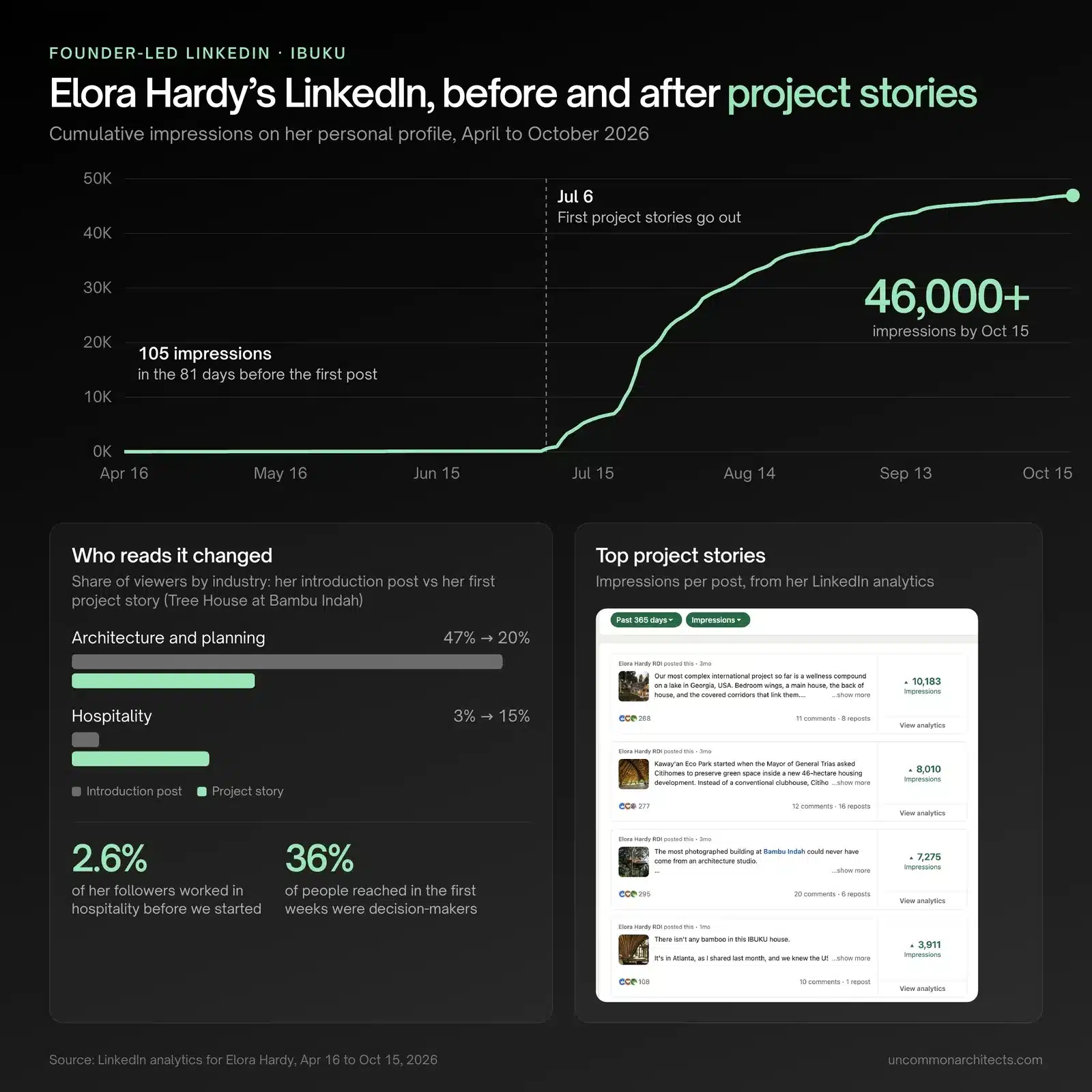
Proof. IBUKU, the Bali studio led by Elora Hardy, is one of the best-known bamboo architecture practices in the world. The Arc at Green School was an Aga Khan Award finalist, and Kawayan was named one of Time’s greatest places. Its audience was mostly press, peers, and students, and the hotel groups and resort investors who commission the work were a small share of it.
We started publishing project stories from Elora’s own LinkedIn profile, in her voice. In the first 9 days, her posts reached 5,475 impressions, against 152 in the previous 81 days, and 36% of the people reached were at decision-maker level. A single project story, the Tree House at Bambu Indah, reached 3,992 impressions on its own. Outreach to hospitality developers, operators, and investors opened 9 qualified calls in about 6 weeks.
None of those calls have become a signed project yet. In a sector with 6 to 36-month cycles, that’s where you’d expect to be after a few months, and it’s why we judge the work by who is in the conversation.
Referral partners: the channel most firms never build on purpose
A large share of architecture work arrives through someone who is not the client. Very few firms build that network on purpose. They wait for the introductions to arrive.
A good referral partner passes 4 tests:
- They sit in front of your ideal client regularly.
- Those clients trust them before you arrive.
- They don’t compete for the same scope of work.
- They’ll share context on the client before an introduction, beyond forwarding an email.
Then keep the relationship alive. Thank them within 24 hours of an introduction. Once a quarter, tell them what happened with every referral: closed, lost, or still talking. Most referral relationships fade because the partner never hears what happened next.
Start with 5. For a firm working with developers, that might be 2 civil engineers, 2 land brokers, and a land-use attorney. For a residential studio, 3 realtors and 2 builders.
The 20% of business development and marketing that wins most of the work
These are the moves we see produce most of the results across our clients, with the time each one takes.
| What to do | Time it takes | Why it pays |
|---|---|---|
| Keep a named list of 25 to 50 target companies | Half a day to build, refreshed each quarter | Every message can be specific, and you can see who is missing |
| Spend 15 minutes a day on people who already engaged | 15 to 20 minutes a day | People viewing your profile or reacting to your posts are the cheapest meetings available |
| Post about real project decisions, with a number | One or two posts a week | On one multifamily client’s account, a project-decision post reached 16,908 impressions in a day |
| Build one proof asset in the buyer’s terms | Once | Developers used the MEEKS density study at site acquisition |
| Run a referral partner routine | About an hour a month | Introductions arrive with context and trust attached |
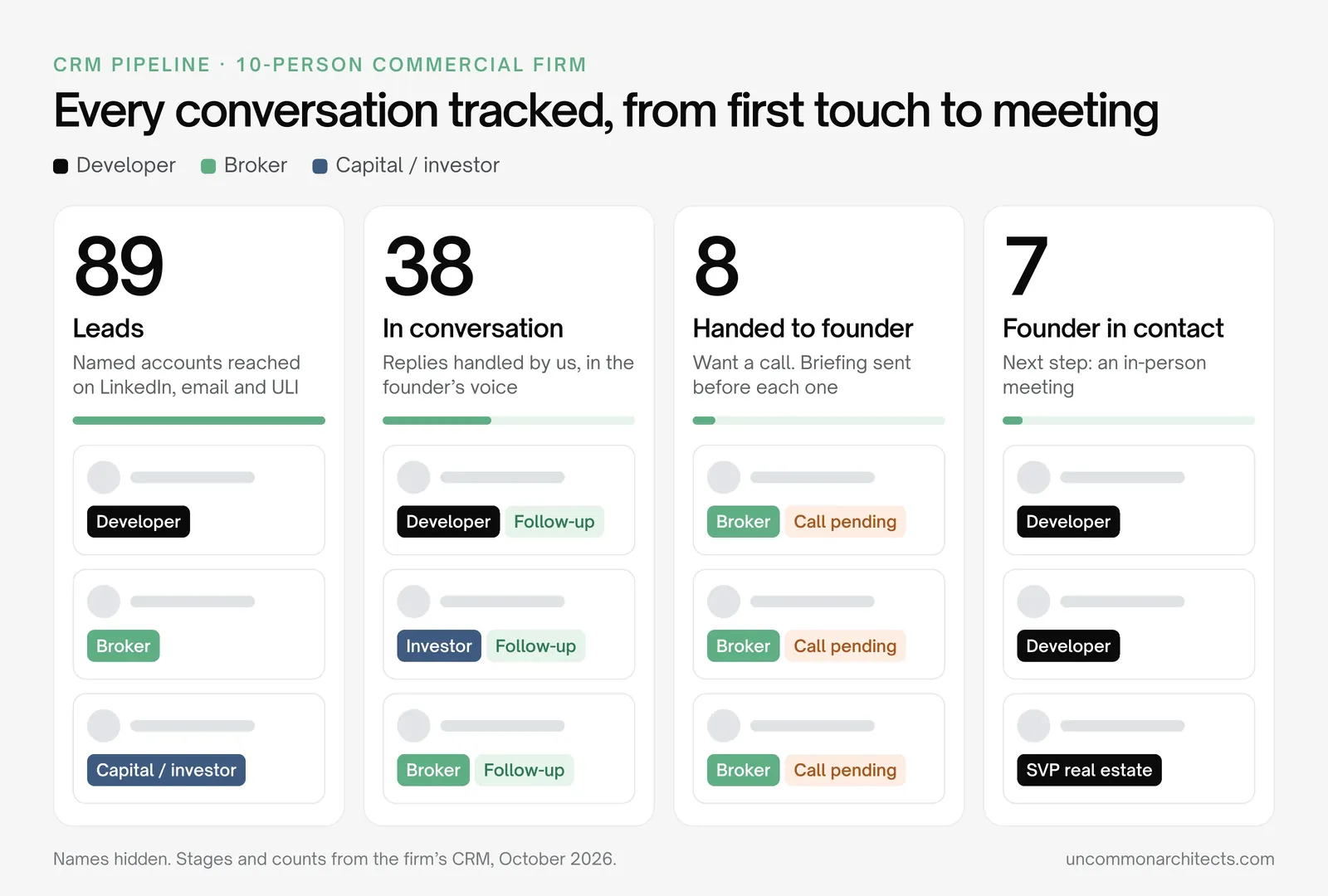
| Keep a CRM with notes before every call | Set up once | At TECHNE it gave the founder context on every prospect without extra prep time |
| Be findable in local search (residential firms) | Ongoing | Studio Couture ranked first locally within six months |
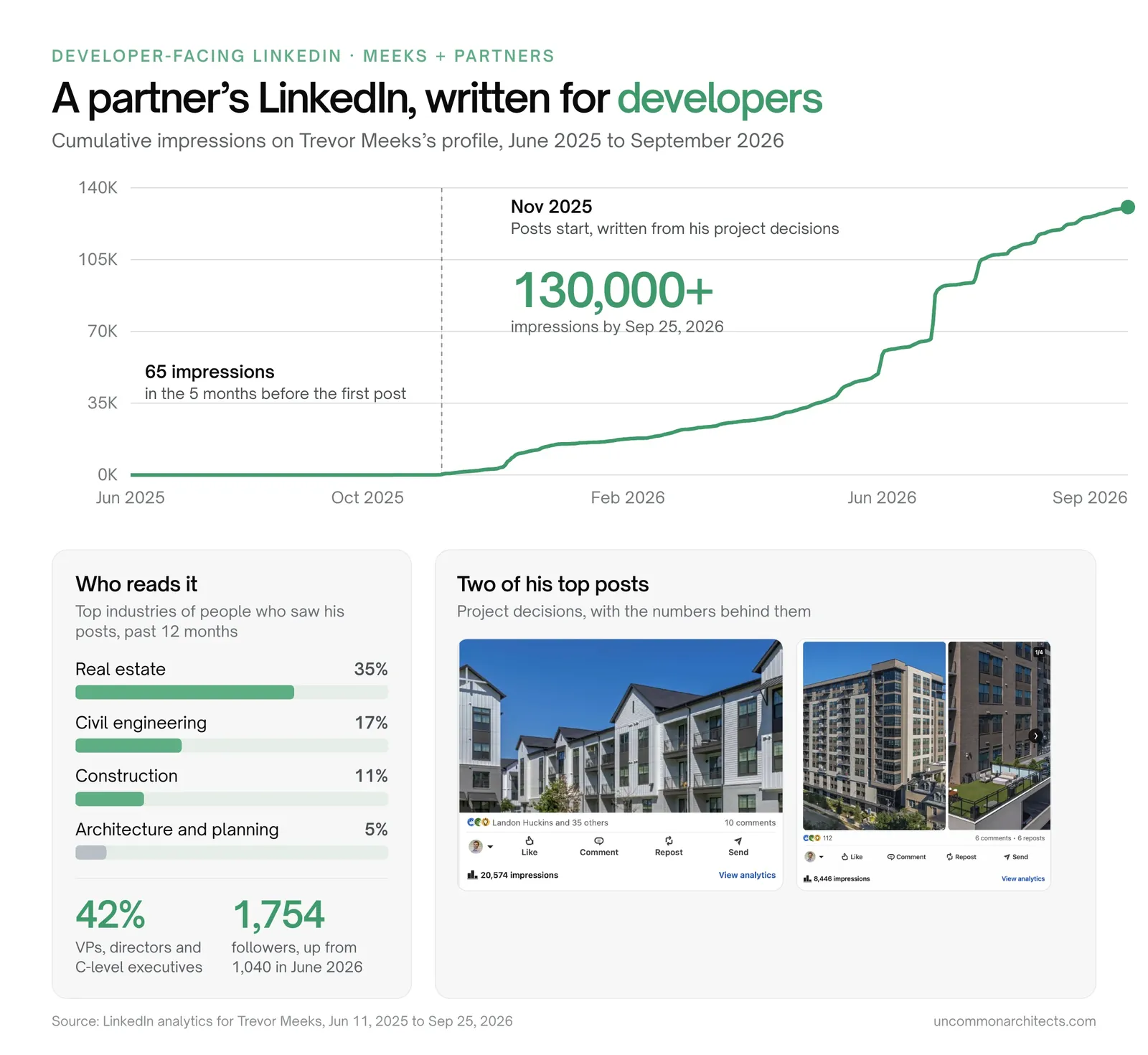
Some things are worth dropping. General market commentary: on that same account, market posts averaged under 150 impressions in the month the project-decision post reached 16,908. Broadcast outreach to long, unresearched lists. And proposals for work the firm wants to leave behind.
A Chicago studio we worked with, overworked and underpriced after 20 years of custom residential and adaptive reuse work, grew revenue 40% over 18 months, doubled its average project value and cut the time it spent on proposals by 80%, mostly by saying no to briefs that didn’t fit.
For the full system behind these moves, read our guide to setting up a business development system.
How long it takes, and what to measure
Longer than most principals hope. Across our clients, nobody has won a project in the first 4 to 6 months, and every firm built relationships that produced projects between months 6 and 18. Selection cycles explain part of it: 1 to 4 weeks for a small developer, 60 to 180 days for an institutional one.
| Window | What to expect | What to measure |
|---|---|---|
| Months 1 to 6 | Executive conversations and qualified meetings. No signed project yet, across any of our clients | Who accepts, replies and books. Audience quality shifts before audience size |
| Months 6 to 18 | Relationships opened earlier start producing projects | Projects that trace back to a named relationship or referral partner |
The funnel is narrow, too. At one mid-size multifamily firm over a single quarter, about 1,200 connection requests produced roughly 34% acceptance, about 150 conversations, and about 7 calls. Early on, who engages tells you more than how many.
Where to start
A workable architecture firm growth strategy starts small: pick 1 client type and 1 stage, and give it 6 months before judging it.
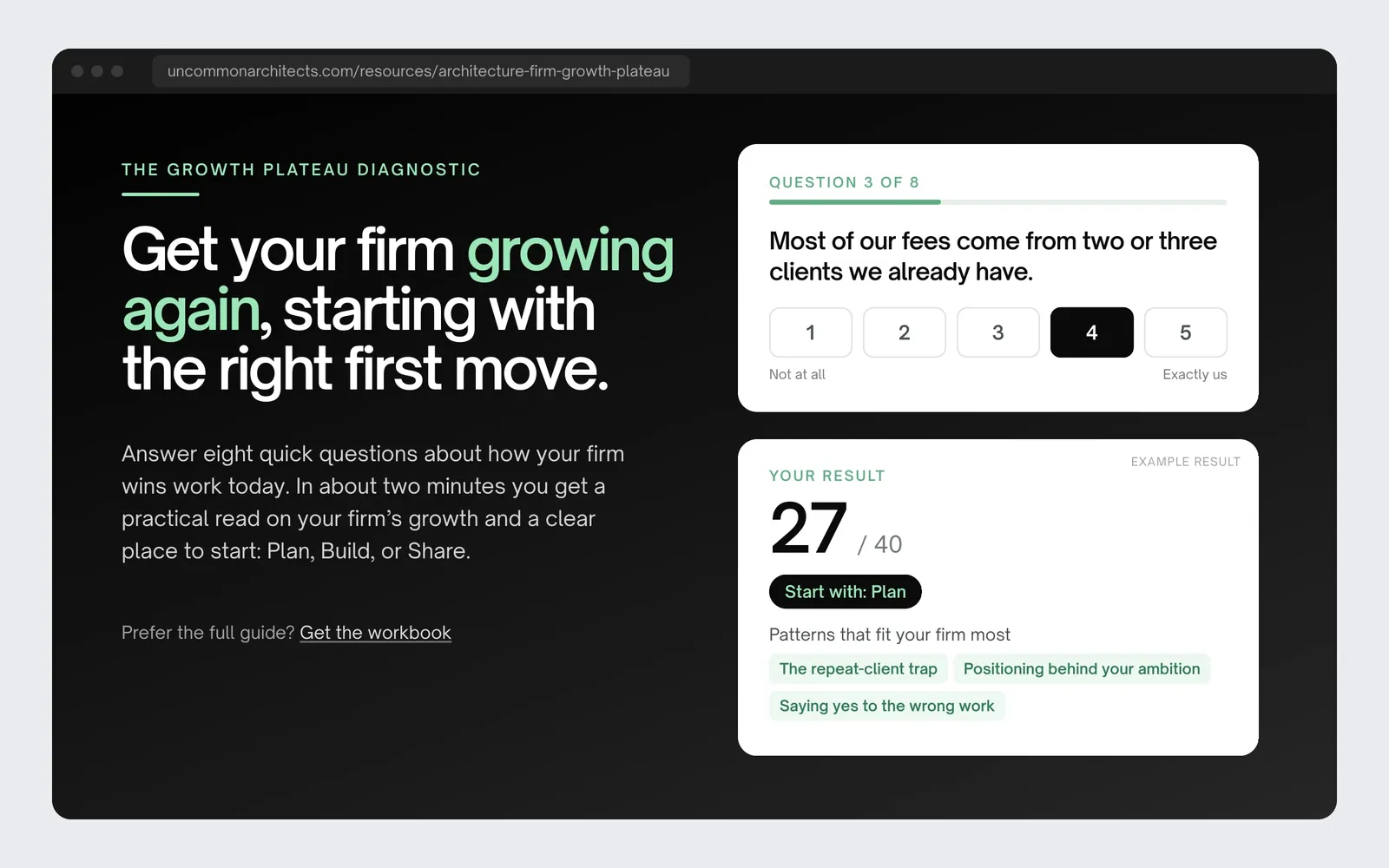
If you’re not sure which stage is holding your firm back, take the growth plateau diagnostic. 8 questions, about 2 minutes, and it shows whether to start with Plan, Build, or Share. The full workbook goes through each of the 8 patterns in more depth.
If you already know what needs fixing and want help running it, our business development program runs the outreach and the content with you. You can book a call to talk it through.
Frequently asked questions
How do you grow an architecture firm?
Choose 1 or 2 client types you want more of, map who decides, refers, and influences in their projects, and put most of your business development effort on the few relationships and channels that convert. Expect conversations within 3 to 6 months and projects within 6 to 18.
Where do architecture firms get most of their work?
From repeat clients and from people who are not the client: brokers, engineers, contractors, and realtors who are in front of the buyer before an architect is hired. Very few firms build that network on purpose.
How do architects get developer clients?
Talk in the developer’s terms (density, entitlement, schedule, whether the site pencils), build relationships with civil engineers and land brokers, keep a named list of 25 to 50 developers, and reach out when something changes, such as a new market, a fundraise, or a new site.
Should an architecture firm hire a business development person?
Usually after the Plan work is done. A new business development hire needs a defined client and proof in that client’s terms before they can aim at anyone.
How long does it take to grow an architecture firm?
Across our clients, relationships produced projects between months 6 and 18, and nobody won a project in the first 4 to 6 months. Institutional developers alone run selection cycles of 60 to 180 days.
Can a small architecture firm grow this way?
Yes. TECHNE is about 10 people and opened 67 executive conversations in 5 months, starting from a single-page website. A clear technical edge and a working CRM counted for more than headcount.