


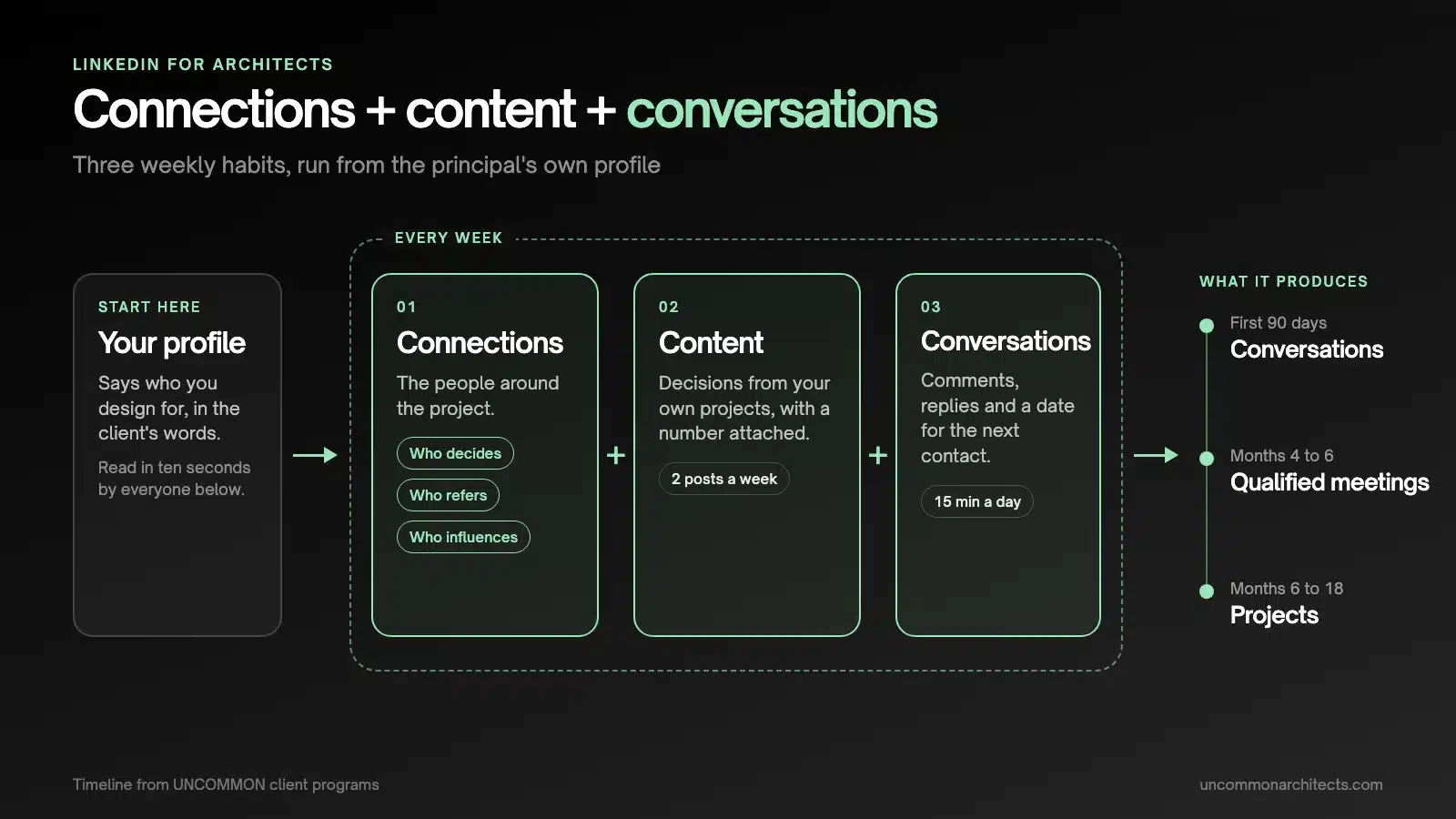
LinkedIn works for architects when three things are true: the principal’s own profile says who the firm works for, the posts are about decisions made on real projects, and somebody replies to the right people every week. Firms that do those three things start having conversations with developers, owners and referral partners within about 90 days. Signed projects come later, usually between month 6 and month 18.
This guide covers each part: who you can reach on LinkedIn and who you can’t, what a client looks for on your profile, who to connect with (the people who decide, the people who refer and the people who influence), what to post, and how a comment becomes a meeting. The numbers come from architecture firms we work with.
Does LinkedIn work for architects?
It depends on who hires you. LinkedIn is strong where the client is a company, and where the people who refer your clients are professionals. It is weak where the buyer is a private individual with nobody around them.
Developers: multifamily, mixed use, industrial
Yes, and active
Posts on density, entitlement, schedule and cost. Direct connection with development leads.
Commercial owners and corporate real estate
Yes
Posts on tenant improvement, rollouts and delivery. Connection with heads of real estate and their brokers.
Institutional clients: education, healthcare, public
Yes, but hired by RFP
Being a known name before the RFP is issued. Connection with capital project directors and owner’s representatives.
Private homeowners with budgets of $1M and up
Rarely as buyers
Reach the people who refer them: realtors, custom home builders, interior designers.
Ultra-high-net-worth collectors
No
Referrals, relationships and press. We tell firms this before they spend an hour on LinkedIn.
Developers we speak with on behalf of clients open LinkedIn to keep track of projects, people and news in their markets. A post about units per acre or an entitlement timeline gets read by them. A post about a design award gets liked by other architects.
LinkedIn is one channel inside business development for an architecture firm. It does one job well: it lets the people who commission buildings, and the people they ask for advice, get used to your name and your thinking before they need an architect.
Why are most architects on LinkedIn followed by other architects?
Because of who you connected with and what you post. Your network began with classmates, former colleagues and consultants. You post finished photography and awards, your peers react, and LinkedIn shows the next post to more people who resemble the ones who reacted. After a few years the people reading your posts are mostly architects, and the firm concludes LinkedIn doesn’t bring work.
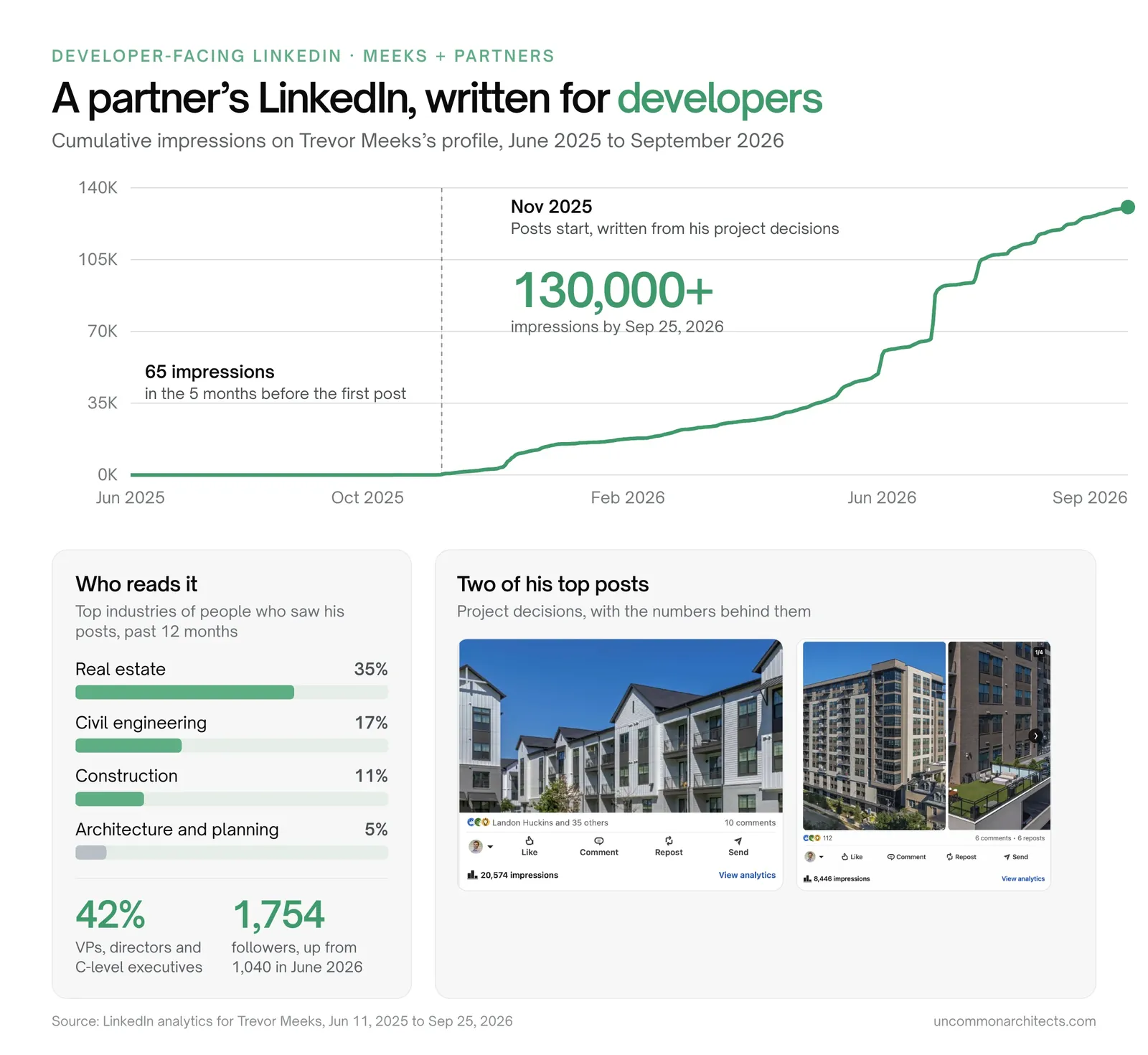
The audience can be changed. At MEEKS + Partners, a 50-person multifamily firm, partner Trevor Meeks had 243 developers from the firm’s target list in his network when we started. Four months later he had 796. He connected with different people and posted about different things.
A year in, the people who saw his posts were 35% real estate, 17% civil engineering and 11% construction. Architecture and planning was 5%. The full account is in the MEEKS + Partners case study.
Free guide · 24 pages
Reading this between meetings?
The 90-day LinkedIn guide for architecture principals has the same steps laid out as a plan: profile and network, posts, conversations. Keep it open next to your profile.
Send me the guideShould you post from your own profile or the company page?
Your own. Clients hire a principal they trust, and on LinkedIn only a person can send a connection request, comment as themselves or start a direct message. A company page can do none of that.
Keep the company page complete, because prospects click through to it: a description that says who you design for, your sectors, and your project posts reshared. Then leave it alone.
At a firm with several partners, start with the partner clients already know by name. If each partner leads a sector, each one posts about that sector.
What should an architect’s LinkedIn profile say?
A client decides in about ten seconds whether you are relevant to them. Most architects’ profiles are written for a hiring manager. Rewrite each part for the person who would commission the work, and for the broker or builder deciding whether to mention your name.
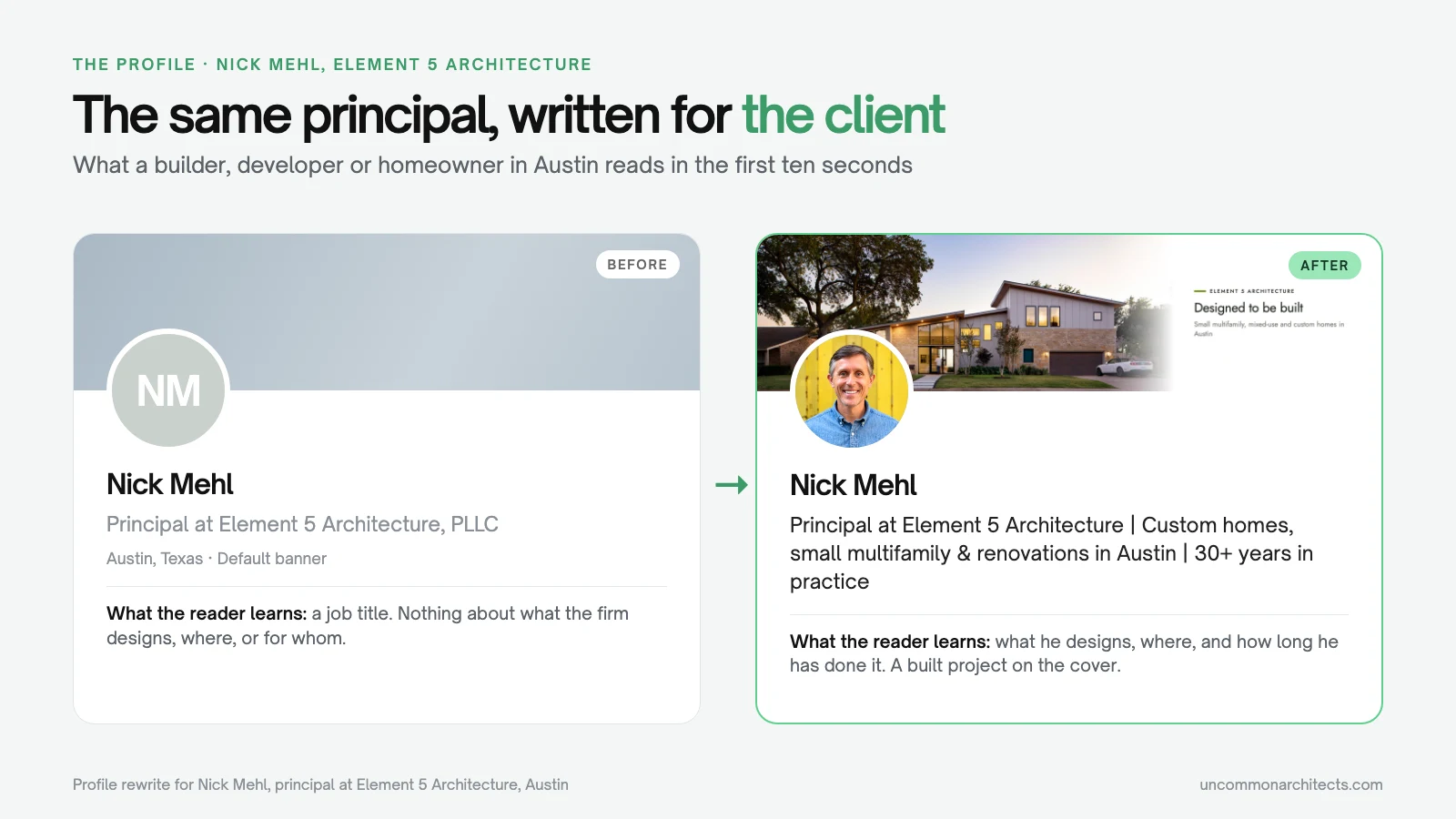
Nick Mehl is a principal at Element 5 Architecture in Austin. His profile had LinkedIn’s default banner and a headline that read “Principal at Element 5 Architecture, PLLC”. The rewrite puts a built project on the cover and names what he designs, where, and for how long.
| Part | What most architects have | What a client needs to read |
|---|---|---|
| Headline | Principal at Element 5 Architecture, PLLC | Principal at Element 5 Architecture | Custom homes, small multifamily & renovations in Austin | 30+ years in practice |
| Banner | Blank, or the logo | One built project, captioned with product type and city |
| About | Firm history and design philosophy | Who you work for, the problems they bring you, 2 or 3 projects with numbers, how to reach you |
| Featured | Empty | One case study, one document a client would use, one way to get in touch |
| Experience | Job titles and dates | Two lines per role on project types and scale |
Who should architects connect with on LinkedIn?
Every project has three kinds of people around it: the person who signs your fee, the people who recommend an architect before one is hired, and the people who shape the shortlist without signing anything. The first group is the obvious one. The second and third are larger, easier to reach, and each of them talks to many clients.
Developers: multifamily, mixed use, build to rent
Who decides
Development managers, heads of acquisitions, principals
Who refers
Land brokers, civil engineers, land-use attorneys, general contractors
Who influences
Lenders, equity partners, development managers who pass names upward
Commercial, corporate and retail rollout
Who decides
Corporate real estate, construction and store development leads
Who refers
Tenant rep and commercial brokers, general contractors
Who influences
Landlords, project managers, brand standards teams
Institutional and public
Who decides
Facilities and capital planning, procurement
Who refers
Owner’s representatives, engineers, partner firms on joint pursuits
Who influences
Selection committees, boards, end users
Custom residential
Who decides
Homeowners, who are rarely on LinkedIn as buyers
Who refers
Realtors, custom home builders, interior designers, landscape architects
Who influences
The builder’s opinion, wealth advisors, family offices
Hospitality
Who decides
Operators, owners, investors
Who refers
Larger firms that need a specialist partner, hospitality consultants
Who influences
Brand operators, investors
The longer version of this map, with the selection cycle for each client type, is in how to grow an architecture firm.
Builders deserve their own line. A general contractor or custom home builder is on site with owners every week and is often the first person an owner asks for an architect’s name. They are easy to reach on LinkedIn, because their own work depends on good relationships with architects. Civil engineers and land brokers are in the same position on the developer side: they are in the deal months before design starts.
That is who ended up reading Trevor Meeks’s posts. The 17% in civil engineering and the 11% in construction are referral partners, and they sit next to the developers in the same feed. For a custom residential firm the same logic points to realtors and builders. Studio Couture designs custom homes in Marin County, where the referral channel is realtors and local business owners, and LinkedIn outreach there produced more than 10 positive replies.
A workable order for building the network:
- Everyone you have already met on a project. Past clients, including the ones from ten years ago, and every consultant and contractor you have worked with.
- Referral partners in your market. Start with 10 builders or contractors and 20 brokers or realtors.
- Decision-makers at named companies with projects in development, with job titles checked one by one.
- Influencers on a live pursuit. The owner’s representative, the lender’s construction lead, the committee members you can identify.
Across the firms we work with, well-targeted connection requests are accepted 37% to 50% of the time. The condition is the targeting. A request sent to a broad list does far worse.
Two practical notes. We keep each account to about 100 requests a week, which stays inside LinkedIn’s limits. And look at the requests already waiting for you. Principals with some recognition often have dozens they never opened, and some of them are owners, builders and developers.
What should architects post on LinkedIn?
Decisions from your own projects, with a number attached. We have the comparison from one partner’s profile at MEEKS + Partners: average impressions per post over 28 days, by type of post.
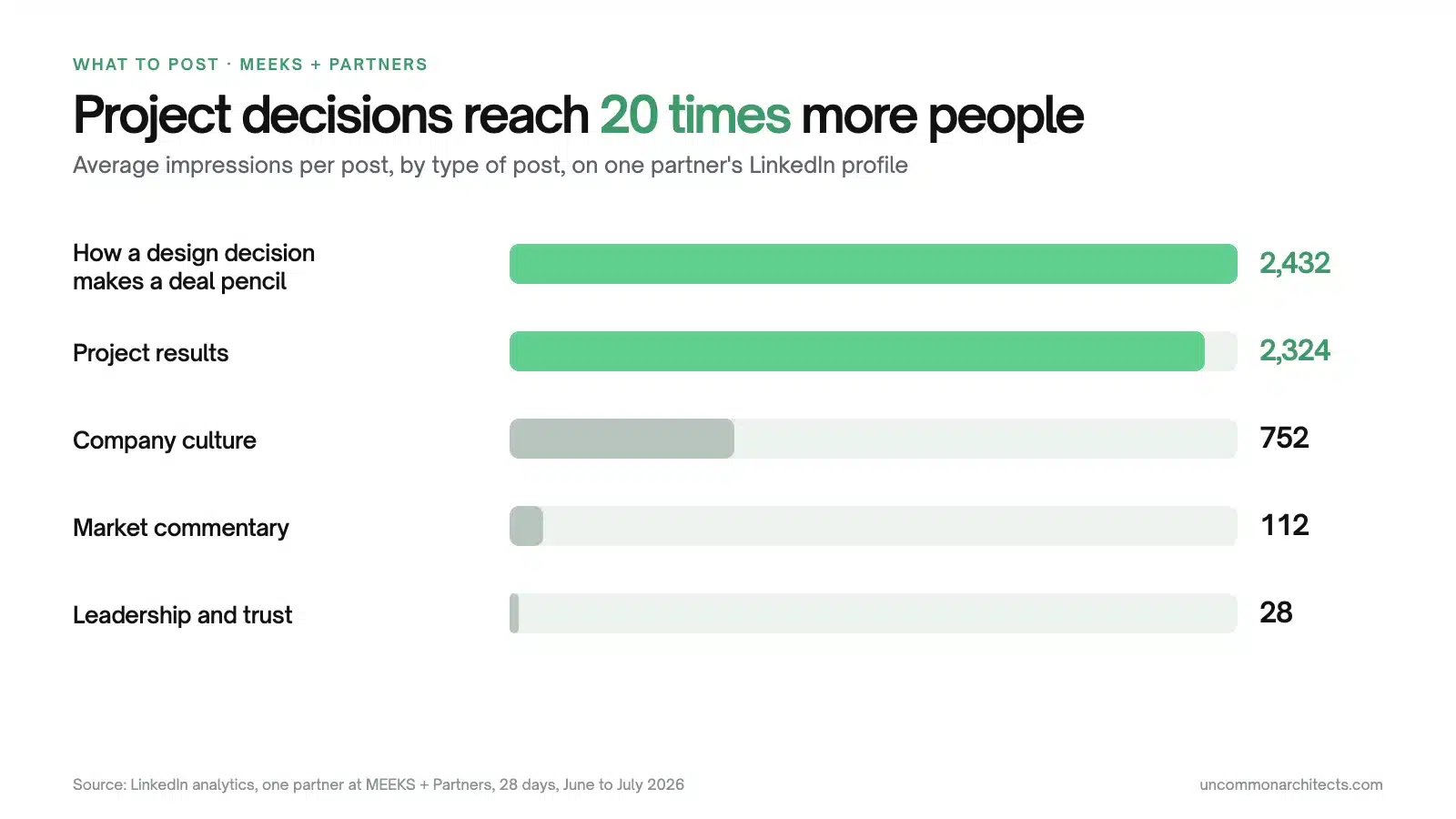
Market commentary is the kind of post most firms assume builds authority. It reached about one twentieth of the audience that the project posts did. We had been drafting those market posts ourselves, so the numbers corrected us as much as anyone.
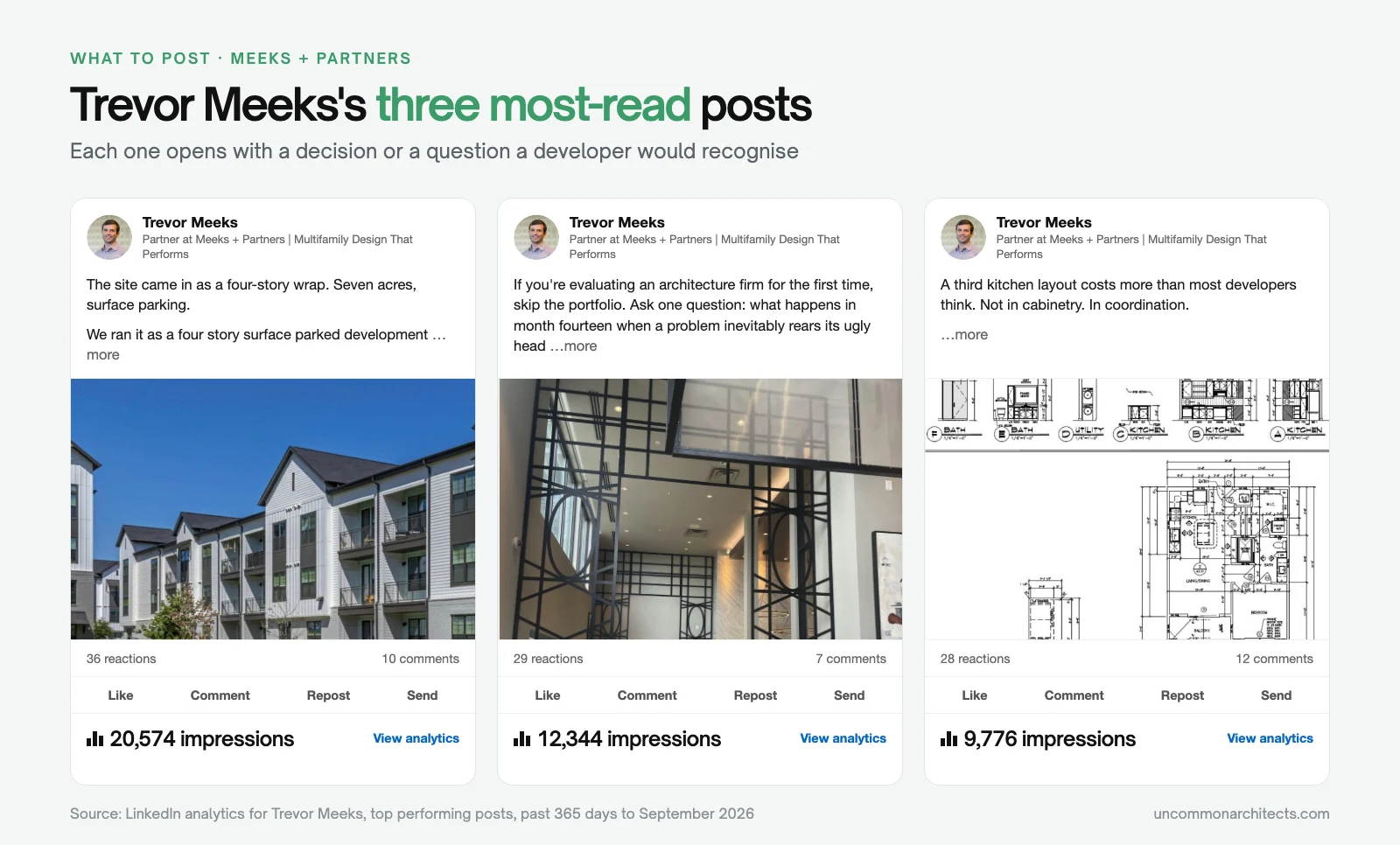
Three posts on the same profile went far past the rest, at 20,574, 12,344 and 9,776 impressions by September 2026. Two are a single project decision with the numbers behind it. The third tells a developer the one question to ask an architecture firm before hiring it. The post on taking a site from a four-story wrap to nine levels brought 50 new followers in one day.
Culture posts had the lowest reach of the useful categories and the highest engagement rate, at 1.0%. They were read by job candidates and by developers checking that the firm is stable. They are worth one slot a month.
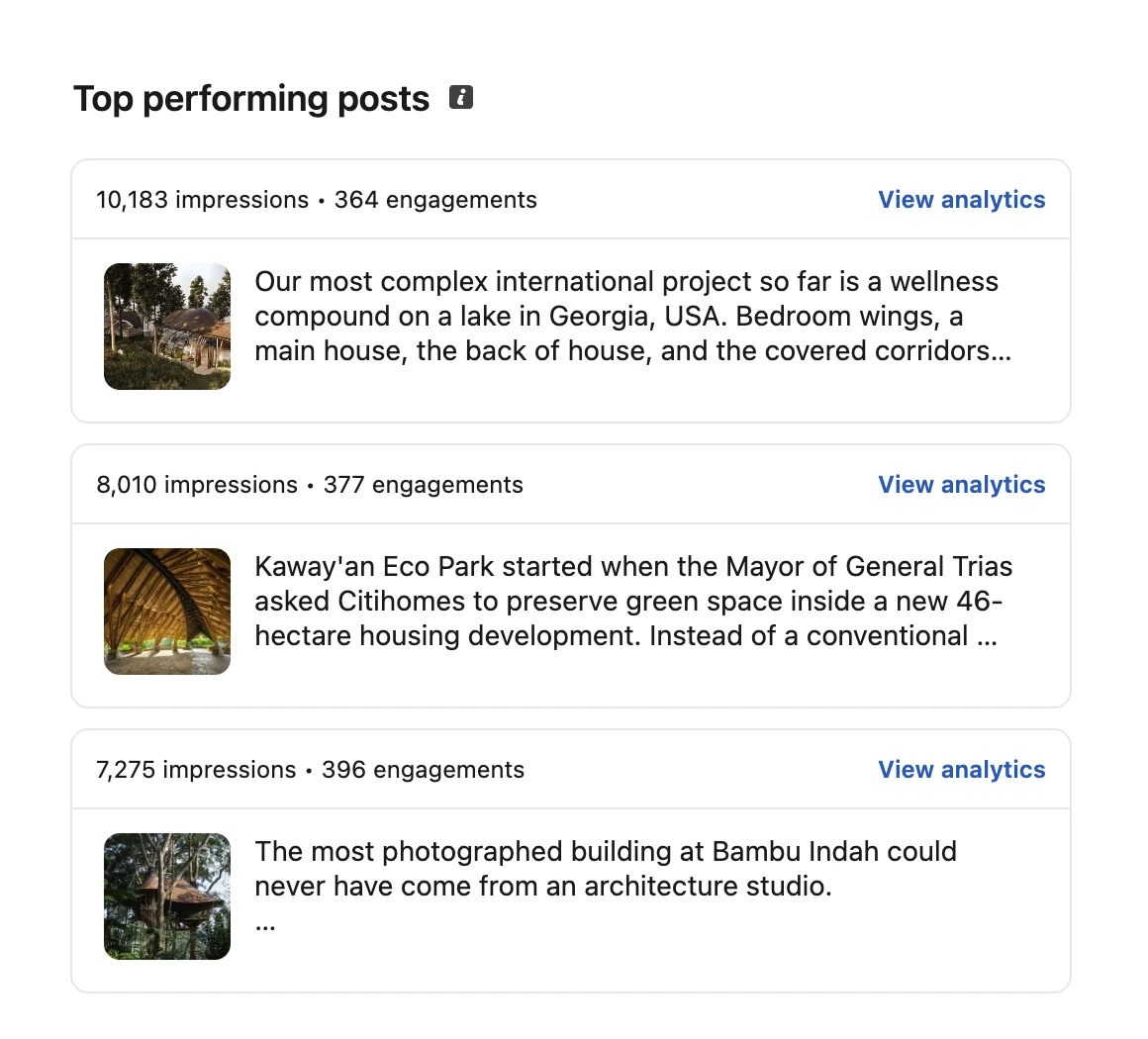
Project stories travel the same way outside multifamily. IBUKU is the Bali studio led by Elora Hardy. Three of her posts, each the story of one project, reached 10,183, 8,010 and 7,275 impressions, with 364 to 396 engagements each.
The shape of a post that gets read by clients
- First line: the decision and the number. “We took this site from a four-story wrap to nine levels.”
- The constraint: what the site, the code or the budget would not allow.
- What you changed: two or three sentences, in the terms your client uses. Units, cost, schedule.
- Who it is for: one line naming the situation where this applies.
You already have the material. Five places to find it this week: a decision you made on a live project, a question a client asked you this month, a constraint in your market such as a code change or an entitlement delay, a completed project with one metric, and something about how the firm staffs and runs a job.
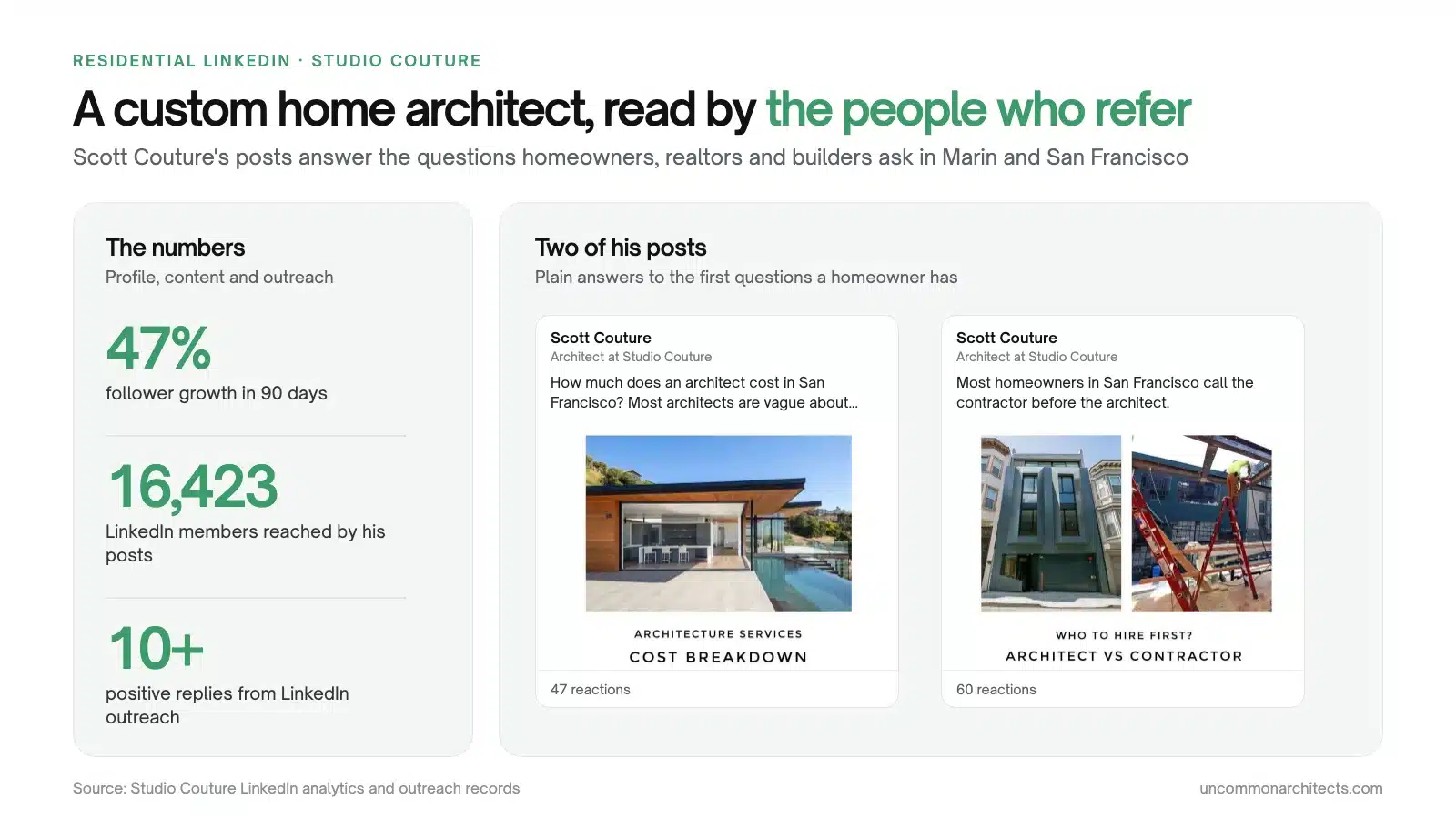
Write for referral partners too. A post on what an architect needs from a builder at preconstruction, or how early a civil engineer should see the site plan, gets read by the people who pass your name on. This holds for residential firms: at Studio Couture, profile and content work aimed at realtors and local owners produced 47% follower growth in 90 days, with posts reaching 16,423 LinkedIn members.
Part 2 of the guide
A month of posts, from projects you have already built.
The guide shows how to plan four weeks of posts in one sitting, and how to write first lines that make a client read on.
Get the post plannerHow often should architects post on LinkedIn?
Twice a week is what we plan for most principals. Once a week is the floor. The whole routine fits in about two hours.
Monday
30 to 40 min
Write and schedule the week’s two posts, or a month’s worth once a month.
Every weekday
15 min
Reply to comments. Comment on two or three posts from people on your target list.
Friday
20 min
Send connection requests. Set a follow-up date for every open conversation.
About two hours a week in total.
On paying to boost posts: we tested a three-day boost of about $30 on a post that was already performing well. Reach went up. It produced no leads. Paid reach is something to look at after six months of steady posting, with tracking in place.
How does a LinkedIn post turn into a client conversation?
Through replies. Posts make your name familiar, and the conversation starts when you write to one person about something specific to them. The sequence we use:
- Connect, with a short note that mentions something real: a project of theirs, a shared contact, an event you both attended.
- For one or two weeks, comment on what they post. Say something an architect would know.
- Send them something they can use: a zoning change on a site near theirs, a study, a relevant project.
- Ask for a short call. On the call, listen for about 70% of the time.
Rules for the first message: under five sentences, one question you are curious about, no portfolio, no deck, no description of your services. Follow up twice at most unless you have something new to say.
With a referral partner the message is easier to write, because you can offer something first: an introduction, a second opinion on a site, a project they could bid.
When the message is about the other person’s priorities, people answer. Reply rates on developer outreach across our clients run from 25% to 45%. TECHNE Architecture, a 10-person California firm, saw a 33% reply rate from developer principals and opened 67 executive conversations in five months, 13 of them with brokers and ULI contacts.
Sometimes the conversation starts from their side. In July 2026 a national multifamily developer contacted MEEKS + Partners after seeing the partners’ posts and their density data. Nobody at the firm had written to them. Four or five people from the developer’s team met with MEEKS and began sending sites to evaluate. One of them put it this way:
“It’s all your stuff getting up everywhere. Who are you guys?”
Every conversation gets a date for the next contact, written down somewhere you will see it. Most of what LinkedIn produces is lost here, between a friendly exchange and the follow-up nobody scheduled. We wrote more about that in how architecture firms build relationships with developers.
How long does LinkedIn take to work for an architecture firm?
Days 1 to 30
Profile rewritten, first 100 to 200 connections, first posts
Look for: who views your profile starts to change. The connections are past contacts, referral partners and target companies.
Days 31 to 60
Posting twice a week, commenting on target accounts
Look for: target job titles among the people reacting.
Days 61 to 90
First direct conversations and calls
Look for: replies, and a few people who ask what you are working on.
Months 4 to 6
Qualified meetings
Look for: MEEKS + Partners had 9 qualified meetings and 28 executive conversations at four months.
Months 6 to 18
Projects
Look for: sites sent for evaluation, introductions from referral partners, RFP invitations.
None of the firms we have worked with won a project from LinkedIn in the first four to six months. Every one of them built relationships that turned into work between month 6 and month 18. A developer who met you in March may not have a site for you until the following spring.
If you need work sooner than that, run LinkedIn alongside the faster routes in how to get architecture clients, starting with past clients.
What should you measure?
Measure who is in your audience before you measure how big it is. The mix of people changes first, and it is the earliest sign the profile and posts are working. On Trevor Meeks’s profile, 42% of the people reading are VPs, directors and C-level executives.
At day 90, check five numbers: how many new connections came from your target and referral lists, how many profile views came from target companies, replies received, conversations held, and meetings booked. Likes are not on the list.
Questions architects ask about LinkedIn
Is LinkedIn or Instagram better for architects?
LinkedIn reaches developers, commercial owners, institutional clients and referral partners. Instagram reaches homeowners and the design press. A firm doing commercial or multifamily work can win clients with LinkedIn alone. A custom residential firm usually wants Instagram for homeowners and LinkedIn for the realtors and builders who refer them.
Do architects need LinkedIn Premium or Sales Navigator?
Not to start. A rewritten profile, 100 good connections and two posts a week need no paid plan. Sales Navigator earns its cost once you are building lists of named companies and job titles every month.
Can someone else write my LinkedIn posts?
Yes, as long as the raw material is yours: the decisions, the numbers, the opinions. A 20-minute call about one project gives a writer enough for three or four posts. That is how our social media and LinkedIn service for architecture firms works, for principals who would rather hand over the writing and the outreach.
Should I accept connection requests from people I don’t know?
Accept the ones who could hire you, refer you or build with you. Leave the ones selling you something.
Where to start
Rewrite your headline today. It takes ten minutes, and it is the first thing every future visitor reads. Then send connection requests to 20 people: ten you would like to work for and ten who could refer you. Post about one decision from a project on your desk this week.
The 90-day LinkedIn guide
Day 1 takes ten minutes. The guide covers the other 89.
24 pages for architecture principals: a profile clients trust, a month of posts planned ahead, replies in 15 minutes a day, and what to check at day 90. Free.
Get the 90-day LinkedIn guide